Despite being a small country, Singapore has a multitude of distinct attractions for tourists to visit, from the magnificent Marina Bay Sands to the cultural streets of Katong. For the free-and-easy tourist, it may be difficult to decide where, when and how to get around the island. Our app is catered to meet these needs.
For a broad overview, here is a youtube link demonstrating all functions and navigation in our app: https://youtu.be/0ArprZBJLEw

UI design & SQLite Database (the app): Valerene Goh
Algorithm: Tracy Yee & Cheryl Goh
(done by Valerene)
A bottom navigation bar is implemented to navigate between the following three fragments. In addition, within “itinerary planning” optimisation function, there is a tab activity of the route.
The first tab contains a wide selection of attractions listed into their respective categories. Each attraction contains a short description of the place for the user to have a quick info readup. If the user is interested in a particular attraction, he can add it to a new or existing itinerary.
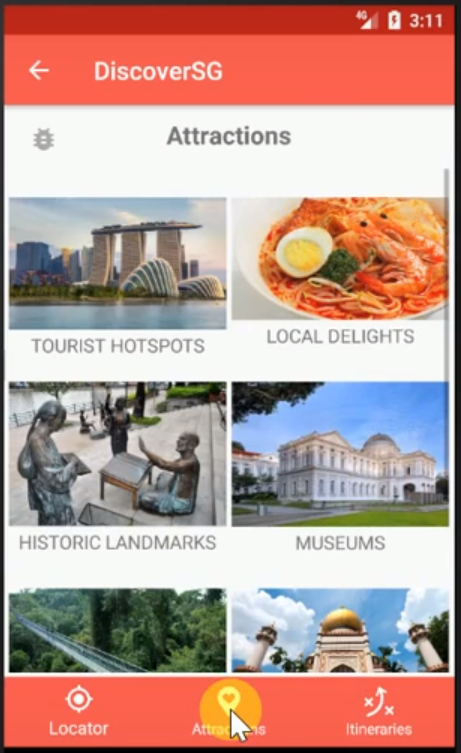
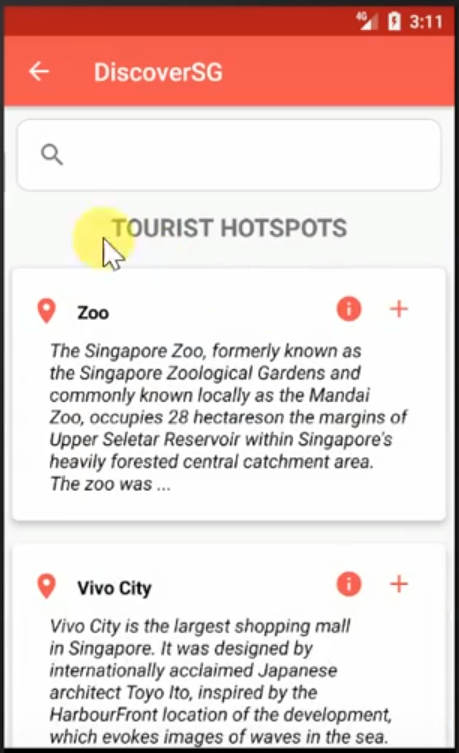
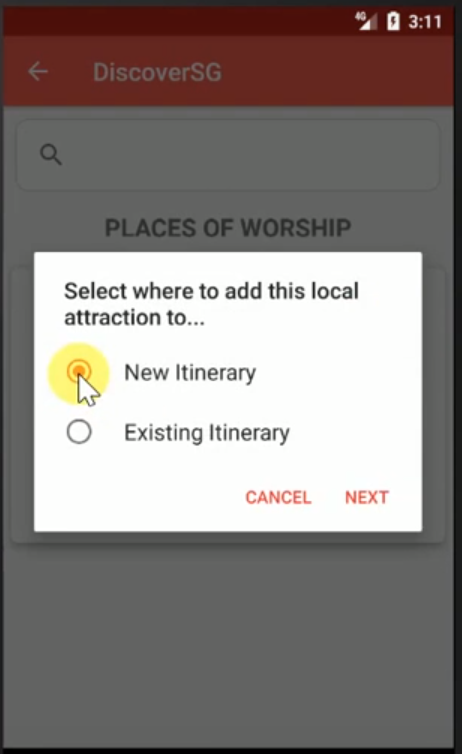
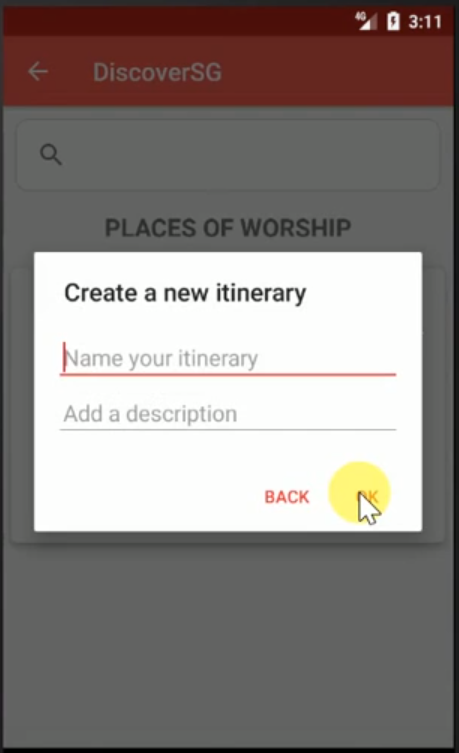
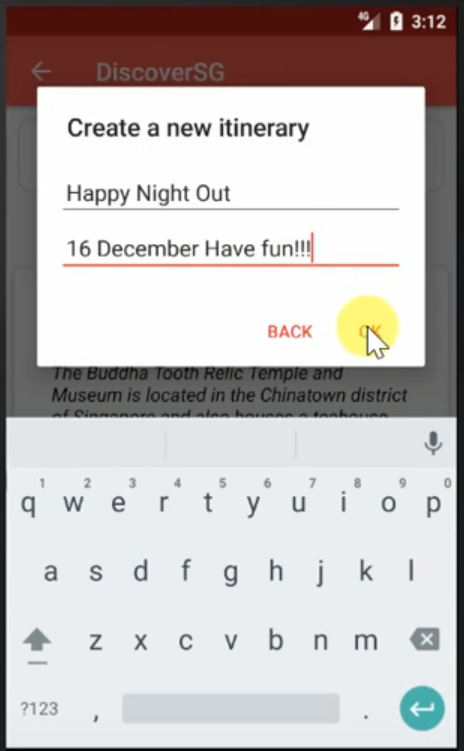
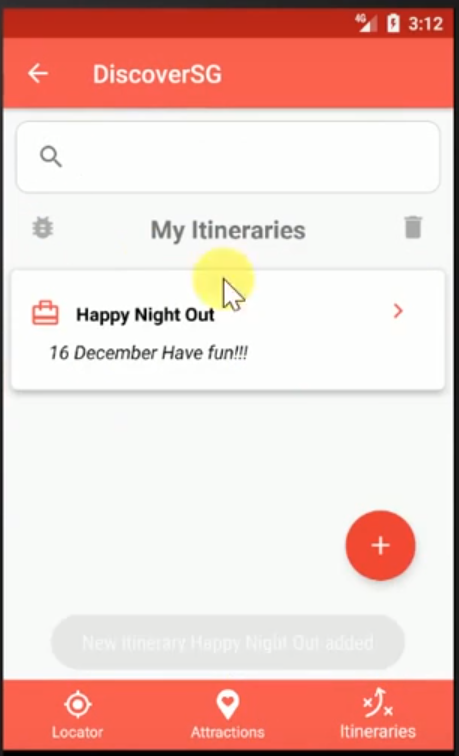
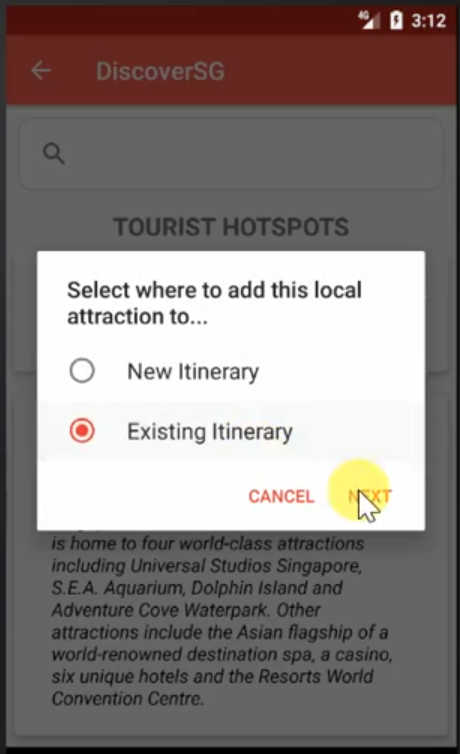
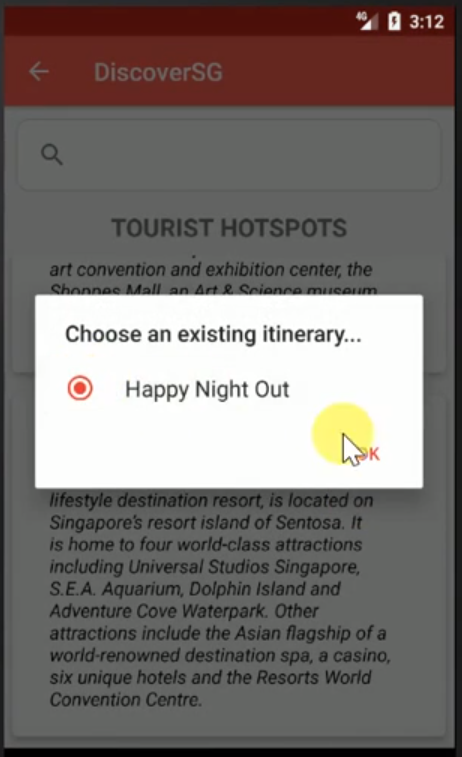
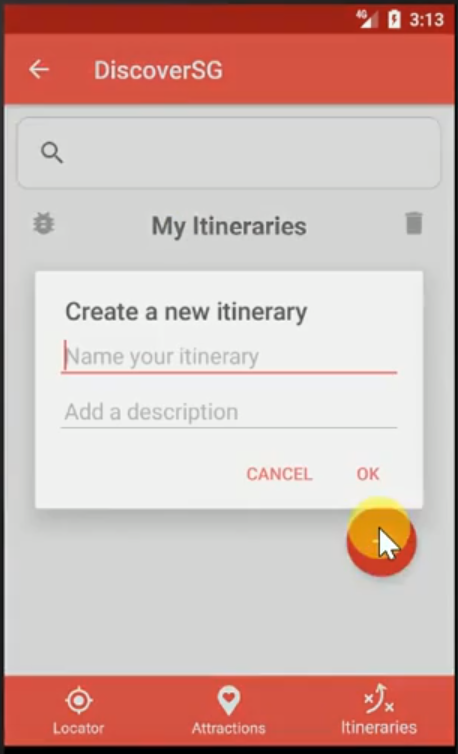
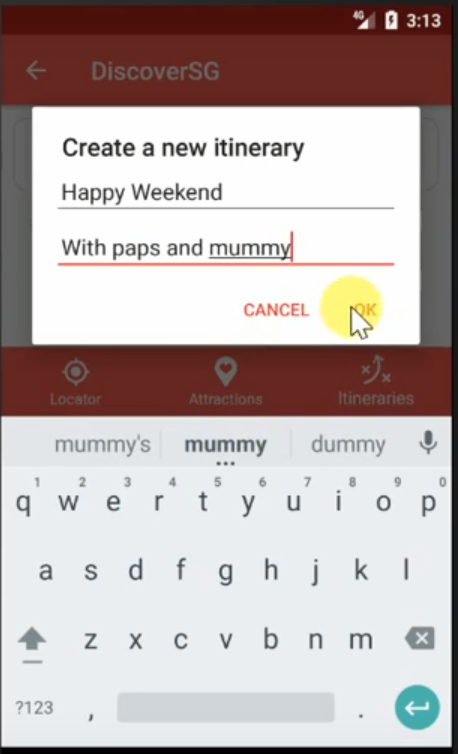
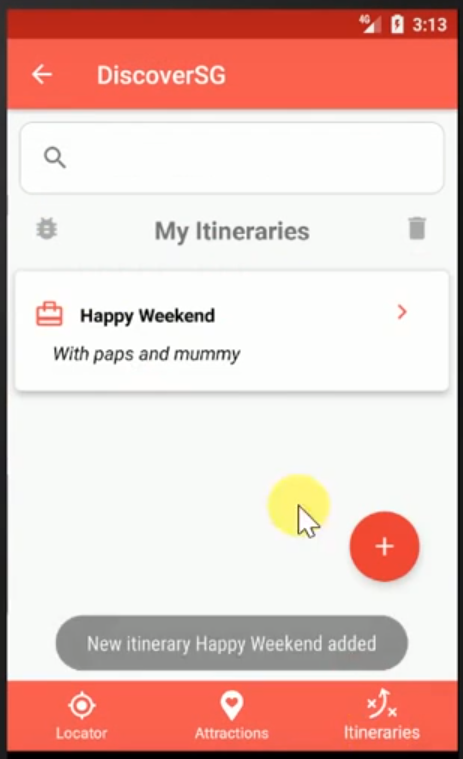
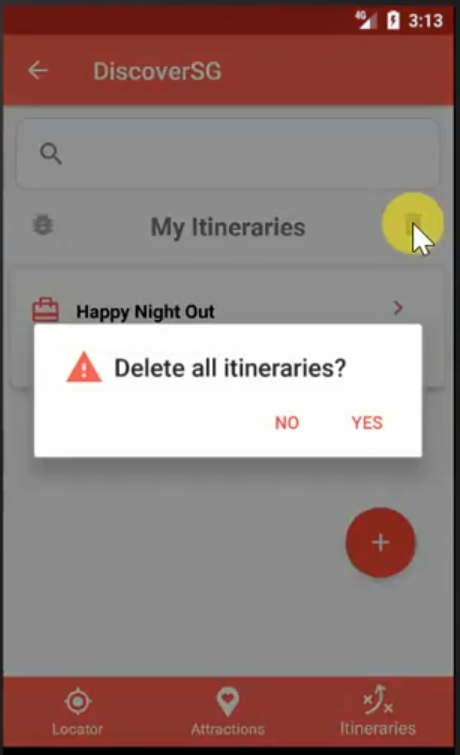
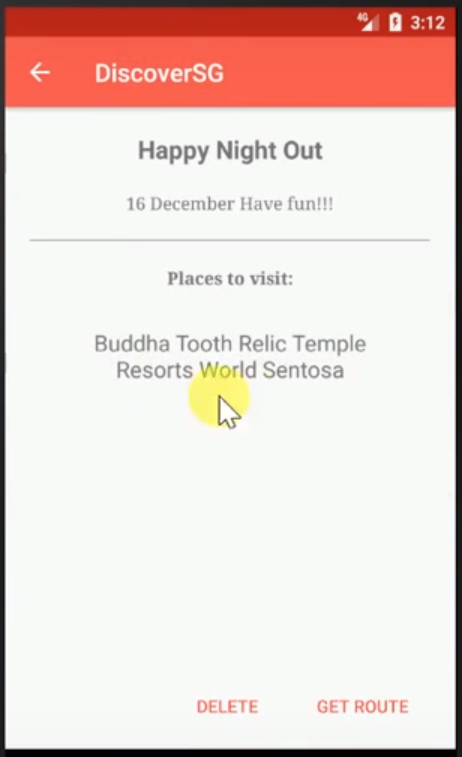
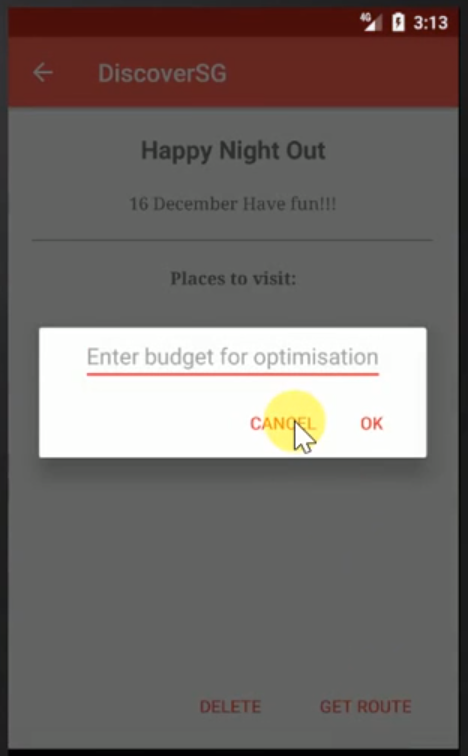
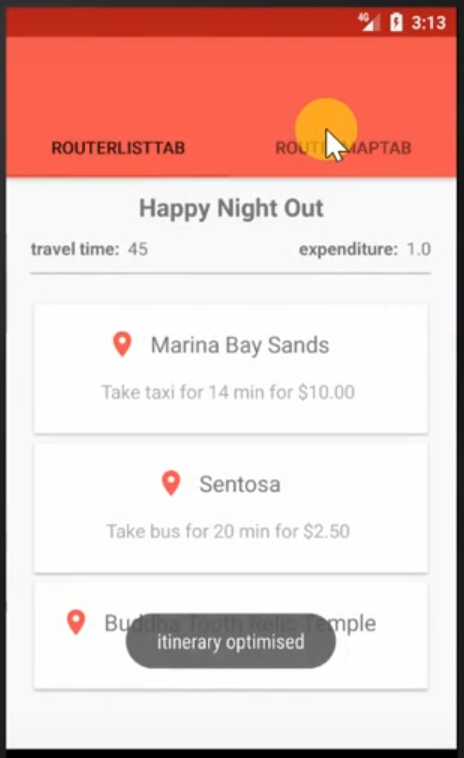
The second tab allows user to manage his itineraries: he can view its details, add a new itinerary, delete all or individual itineraries and derive an optimal route based on all the attractions listed in a particular itinerary. Upon entering a budget, an algorithm is run to derive an optimal path for that itinerary that falls within the given budget, providing all the necessary details on transport mode, time and expenditure. On the adjacent tab, the route is displayed on a map fragment for an overarching view of the itinerary travel plan.
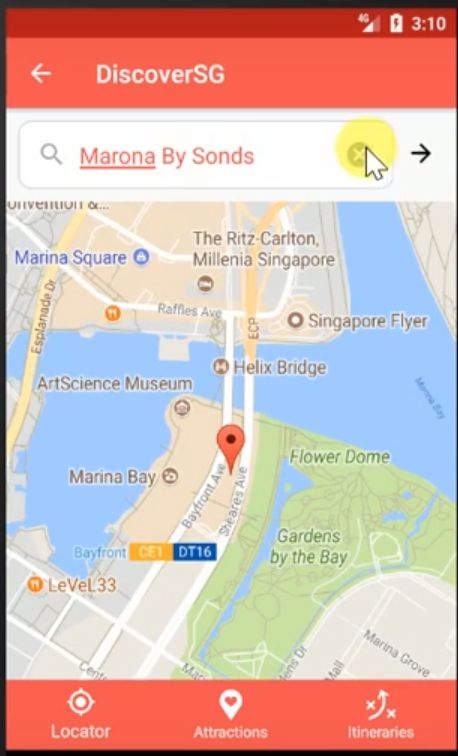
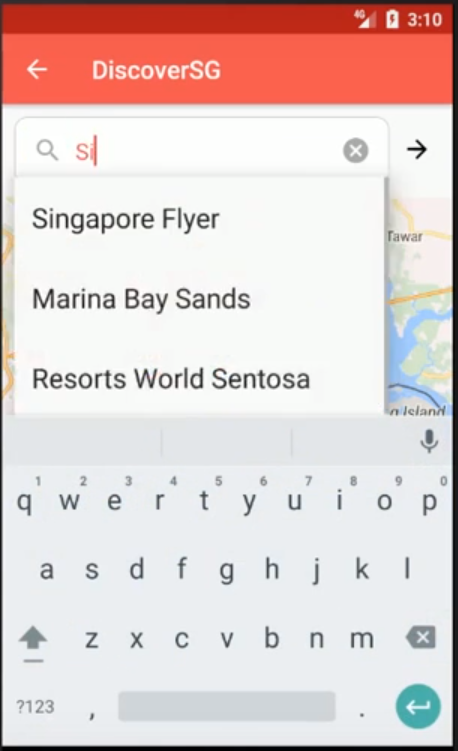
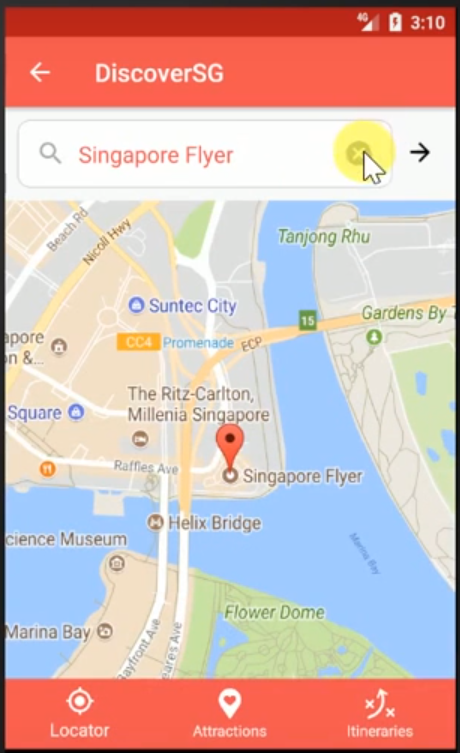
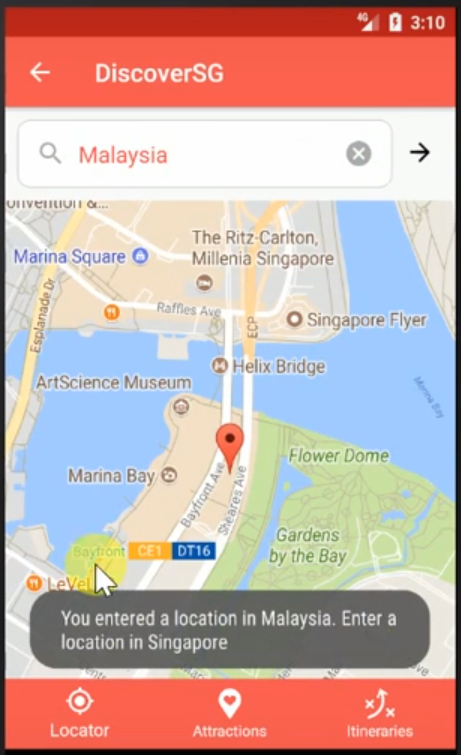
The final tab of DiscoverSG allows tourists to search for any location they want that is within Singapore and the view will be displayed on a map. The search view has a fuzzy spell checker and autocomplete function of all the attractions in the database to produce quick matches. If the location entered is not in Singapore, a toast will prompt the user to re-enter.
● Recycler views are implemented in three parts of the app: each category page of “Browse Attractions”, “Itinerary Planning” main page and the display route details of after optimisation page.
● A single SQLite external database is implemented, which houses and chooses between two internal database to run - one for attractions and one for itineraries. Each database has its own custom set of methods to implement (DbManager). All attractions are loaded from the json file “attractions.json” upon one-time creation of the table. Note: A secondary data file “attractions2.json” containing 100 more attractions can be uploaded by swapping the two file names and changing the attractions table version under its DbHelper to x+1. However, these additional data do not contain to-from time-cost details of various transport modes as they were not provided.
● As aforementioned, the raw folder contains internal JSON storage of the attractions. Each attraction contains its name, category, details (which we generated separately using Wikipedia API) and lat long (which is extraneous data).
● In Function 2, the fuzzy spellchecker computes the levenshtein distance between two strings - the ones inputted by the user and the ones in our database. We set the similarity factor to 0.7. This, compounded with the autocomplete function, allows more flexibility than implementing a regex method, which requires the developer to update the regex methods when new attractions are added to the attractions data.
● The categories page utilizes a custom gridview to house its images and texts. Upon clicking on one of it, the intent passes an extra information - the name of the category - which will call upon all the attractions in the database containing that category name.
(done by Tracy and Cheryl)
Data Collection: We collated the data provided at the end of the handout into corresponding tables of costs and times needed to travel between locations and manually typed out into three 3d arrays ( walkTrans , publicTrans and taxiTrans ) containing the cost-time information from one destination to another for the corresponding transportation mode.
The brute force algorithm generates the optimal route for a given set of attractions (obtained from user input) by systematically enumerating all possible candidates for the solution. Given a list of n attractions, the total time complexity of the brute force algorithm is O(n*n!):
- Add each attraction in a single permutation (total n attractions) to an ArrayList → O(n)
- Add each permutation (n! possible permutations in total) to another ArrayList → O(n!)
- Then, the algorithm computes the time-cost average of each path [O(n)] in each route [O(n!)] by taking the average of the (timecost) of the three transport modes (walk, public transport, taxi), which is O(nn!) total time complexity.
- The algorithm finally compares the time-cost averages of all the possible permutations to obtain the optimal travel route (route with the lowest time-cost average).
For our fast solver, we made use of the Nearest Neighbour (NN) algorithm as it is intuitive and fast. To find the optimal route given n attractions, the NN algorithm starts with the initial location (in this case, the Marina Bay Sands Hotel) and repeatedly visits the nearest unvisited attraction until all the attractions have been visited. The algorithm then returns to the initial location (in this case, the Marina Bay Sands Hotel). The time complexity of this algorithm is:
- Find the nearest neighbour for each point → O(n)
- Compute the time-cost average (mentioned above) from source to all points → O(n)
- Repeat steps 1 and 2 n times for n attractions → O(n^2) Hence, the total time complexity is O(n^2 + n^2) = O(n^2), which is polynomial (decently fast).
Since this algorithm is a greedy algorithm, it yields quick results but compromises on the accuracy ( yields a path 25% longer than the shortest possible path on average). Hence, to further optimise the “optimal” route generated by the NN algorithm, we used the 2-opt technique (iteratively remove two edges and replace them with two different edges that reconnect the fragments into a new and shorter route). Furthermore, starting with the NN algorithm rather than using the 2-opt algorithm from scratch decreases the time complexity of the 2-opt algorithm from O(n log(n)) to O(n). Hence, the total time complexity of the NN-2opt algorithm is O(n^2 + n) = O(n^2) and the accuracy is further improved to give a reasonably good solution that is close enough to the shortest possible path.
We then set the default transportation mode for each path in the optimal route to be by Taxi as it is the fastest and hence most optimal. The total transport cost for the optimal route is then calculated and the path with the shortest travel time is iteratively replaced with public transport if the budget is exceeded (start replacing with walking if all paths are public transport and budget is still exceeded). This is to ensure that the total transport time is minimised while still staying within the constraint of the daily transport budget.
In conclusion, the fast solver, O(n^2), is faster than the brute force solver, O(n*n!), but it is less accurate as it does not actually calculate out all the possible routes and their transport times and costs (hence its speed). Hence, to ensure a balance of speed and accuracy, we implement the brute force solver if the number of attractions entered is less than 10, and the fast solver for 10 or more attractions. For testing, we ran the provided data on the mobile phone with a budget of $20. The brute force solver took 2.6s while the fast solver took 2.4s, which are close to the industry standard of <2s app loading time. Hence, we concluded that for fewer attractions, the running time for both solvers are approximately the same, hence our decision to use the brute force solver for fewer attractions as it is more accurate.