Languages: English | 简体中文 | 日本語


A local-first knowledge compiler for AI agents, built on the LLM Wiki pattern. Most "chat with your docs" tools answer a question and throw away the work. SwarmVault keeps a durable wiki between you and raw sources — the LLM does the bookkeeping, you do the thinking.
Documentation on the website is currently English-first. If wording drifts between translations, README.md is the canonical source.
SwarmVault uses three layers, following the pattern described by Andrej Karpathy:
- Raw sources (
raw/) — your curated collection of source documents. Books, articles, papers, transcripts, code, images, datasets. These are immutable: SwarmVault reads from them but never modifies them. - The wiki (
wiki/) — LLM-generated and human-authored markdown. Source summaries, entity pages, concept pages, cross-references, dashboards, and outputs. The wiki is the persistent, compounding artifact. - The schema (
swarmvault.schema.md) — defines how the wiki is structured, what conventions to follow, and what matters in your domain. You and the LLM co-evolve this over time.
In the tradition of Vannevar Bush's Memex (1945) — a personal, curated knowledge store with associative trails between documents — SwarmVault treats the connections between sources as valuable as the sources themselves. The part Bush couldn't solve was who does the maintenance. The LLM handles that.
Turn books, articles, notes, transcripts, mail exports, calendars, datasets, slide decks, screenshots, URLs, and code into a persistent knowledge vault with a knowledge graph, local search, dashboards, and reviewable artifacts that stay on disk. Use it for personal knowledge management, research deep-dives, book companions, code documentation, business intelligence, or any domain where you accumulate knowledge over time and want it organized rather than scattered.
SwarmVault turns the LLM Wiki pattern into a local toolchain with graph navigation, search, review, automation, and optional model-backed synthesis. You can also start with just the standalone schema template — zero install, any LLM agent — and graduate to the full CLI when you outgrow it.
SwarmVault requires Node >=24.
npm install -g @swarmvaultai/cliVerify the install:
swarmvault --versionUpdate to the latest published release:
npm install -g @swarmvaultai/cli@latestThe global CLI already includes the graph viewer workflow and MCP server flow. End users do not need to install @swarmvaultai/viewer separately.
my-vault/
├── swarmvault.schema.md       user-editable vault instructions
├── raw/                       immutable source files and localized assets
├── wiki/                      compiled wiki: sources, concepts, entities, code, outputs, graph
├── state/                     graph.json, search.sqlite, embeddings, sessions, approvals
├── .obsidian/                 optional Obsidian workspace config
└── agent/                     generated agent-facing helpers
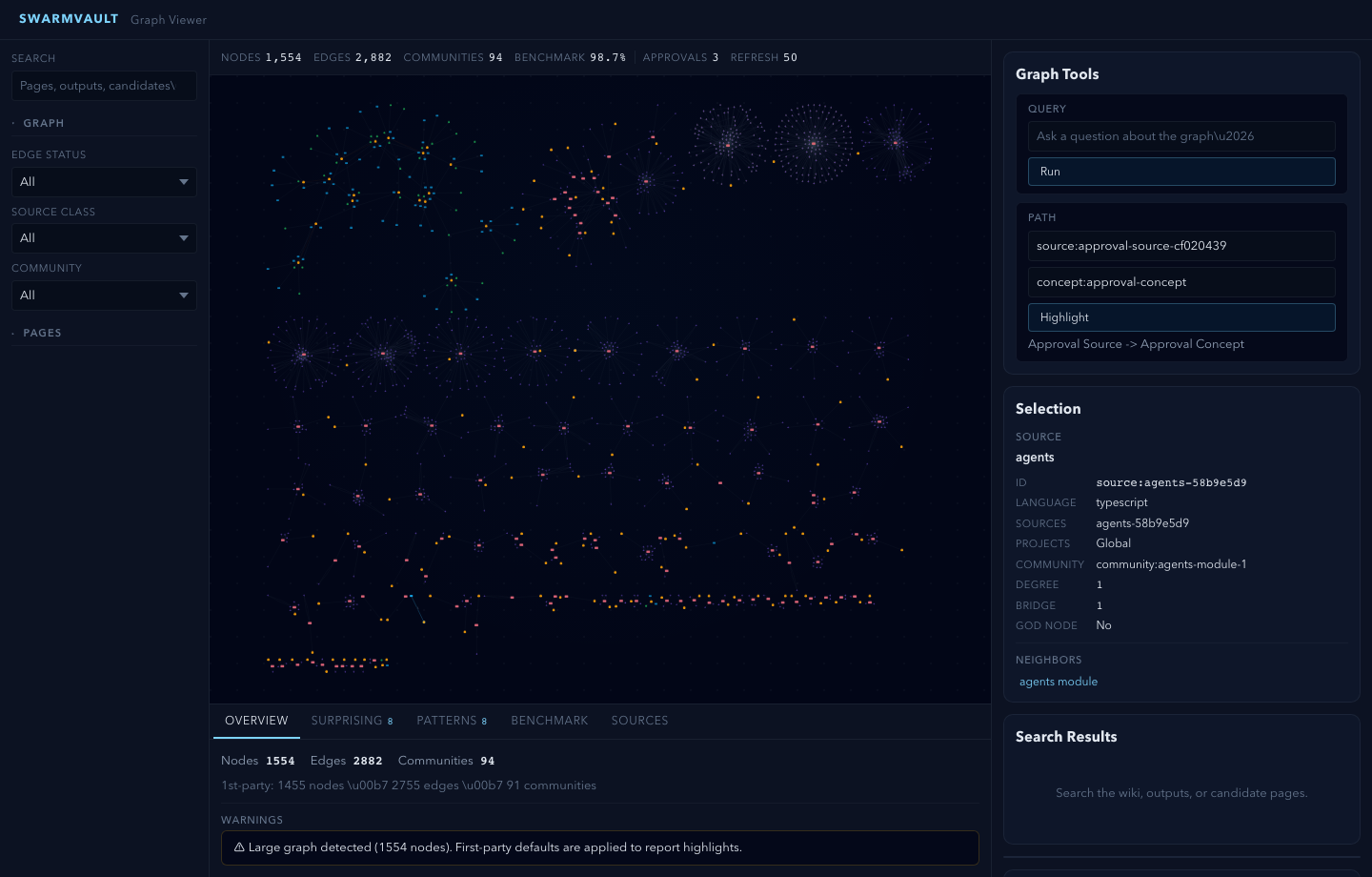
swarmvault init --obsidian --profile personal-research
swarmvault source add https://github.com/karpathy/micrograd
swarmvault source add https://example.com/docs/getting-started
swarmvault ingest ./meeting.srt --guide
swarmvault source session transcript-or-session-id
swarmvault ingest ./src --repo-root .
swarmvault add https://arxiv.org/abs/2401.12345
swarmvault compile
swarmvault graph blast ./src/index.ts
swarmvault query "What is the auth flow?"
swarmvault graph serve
swarmvault graph export --report ./exports/report.html
swarmvault graph push neo4j --dry-run
Need the fastest first pass over a local repo or docs tree? swarmvault scan ./path --no-serve initializes the current directory as a vault, ingests that directory, compiles it, and skips opening the graph viewer when you only want the artifacts.
For very large graphs, swarmvault graph serve and swarmvault graph export --html automatically start in overview mode. Add --full when you want the entire canvas rendered anyway.
When the vault lives inside a git repo, ingest, compile, and query also support --commit so the resulting wiki/ and state/ changes can be committed immediately. compile --max-tokens <n> trims lower-priority pages when you need the generated wiki to fit a bounded context window.
swarmvault init --profile accepts default, personal-research, or a comma-separated preset list such as reader,timeline. The personal-research preset turns on both profile.guidedIngestDefault and profile.deepLintDefault, so ingest/source and lint flows start in the stronger path unless you pass --no-guide or --no-deep. For custom vault behavior, edit the profile block in swarmvault.config.json and keep swarmvault.schema.md as the human-written intent layer.
You do not need API keys or an external model provider to start using SwarmVault. The built-in heuristic provider supports local/offline vault setup, ingest, compile, graph/report/search workflows, and lightweight query or lint defaults.
If you want a fully local setup with sharp concept, entity, and claim extraction, pair the free Ollama runtime with Google's Gemma model. No API keys required.
ollama pull gemma4{
"providers": {
"llm": {
"type": "ollama",
"model": "gemma4",
"baseUrl": "http://localhost:11434/v1"
}
},
"tasks": {
"compileProvider": "llm",
"queryProvider": "llm",
"lintProvider": "llm"
}
}When you run compile/query with only the heuristic provider, SwarmVault surfaces a one-time notice pointing you here. Set SWARMVAULT_NO_NOTICES=1 to silence it. Any other supported provider (OpenAI, Anthropic, Gemini, OpenRouter, Groq, Together, xAI, Cerebras, openai-compatible, custom) works too.
For local semantic graph query without API keys, use an embedding-capable local backend such as Ollama instead of heuristic:
{
  "providers": {
    "local": {
      "type": "heuristic",
      "model": "heuristic-v1"
    },
    "ollama-embeddings": {
      "type": "ollama",
      "model": "nomic-embed-text",
      "baseUrl": "http://localhost:11434/v1"
    }
  },
  "tasks": {
    "compileProvider": "local",
    "queryProvider": "local",
    "embeddingProvider": "ollama-embeddings"
  }
}
With an embedding-capable provider available, SwarmVault can also merge semantic page matches into local search by default. tasks.embeddingProvider is the explicit way to choose that backend, but SwarmVault can also fall back to a queryProvider with embeddings support. Set search.rerank: true when you want the configured queryProvider to rerank the merged top hits before answering.
For cloud-hosted models, add a provider block with your API key:
{
  "providers": {
    "primary": {
      "type": "openai",
      "model": "gpt-4o",
      "apiKeyEnv": "OPENAI_API_KEY"
    }
  },
  "tasks": {
    "compileProvider": "primary",
    "queryProvider": "primary",
    "embeddingProvider": "primary"
  }
}
See the provider docs for optional backends, task routing, and capability-specific configuration examples.
The fastest way to make SwarmVault useful is the managed-source flow:
swarmvault source add ./exports/customer-call.srt --guide
swarmvault source add https://github.com/karpathy/micrograd
swarmvault source add https://example.com/docs/getting-started
swarmvault source list
swarmvault source session file-customer-call-srt-12345678
swarmvault source reload --all
source add registers the source, syncs it into the vault, compiles once, and writes a source-scoped brief under wiki/outputs/source-briefs/. Add --guide when you want a resumable guided session under wiki/outputs/source-sessions/, a staged source review and source guide, plus approval-bundled canonical page edits when profile.guidedSessionMode is canonical_review. Profiles using insights_only keep the guided synthesis in wiki/insights/ instead. Set profile.guidedIngestDefault: true in swarmvault.config.json to make guided mode the default for ingest, source add, and source reload; use --no-guide when you need the lighter path for a specific run. It now works for recurring local files as well as directories, public repos, and docs hubs. Use ingest for deliberate one-off files or URLs, and use add for research/article normalization.
Set up your coding agent so it knows about the vault:
swarmvault install --agent claude --hook    # Claude Code + graph-first hook
swarmvault install --agent codex            # Codex
swarmvault install --agent cursor           # Cursor
swarmvault install --agent copilot --hook   # GitHub Copilot CLI + hook
swarmvault install --agent gemini --hook    # Gemini CLI + hook
swarmvault install --agent trae             # Trae
swarmvault install --agent claw             # Claw / OpenClaw skill target
swarmvault install --agent droid            # Droid / Factory rules target
Or expose the vault directly over MCP:
swarmvault mcpUsing OpenClaw or ClawHub? Install the packaged skill with:
clawhub install swarmvaultThat installs the published SKILL.md plus a ClawHub README, examples, references, troubleshooting notes, and validation prompts. Keep the CLI itself updated with npm install -g @swarmvaultai/cli@latest.
| Input | Extensions / Sources | Extraction |
|---|---|---|
.pdf |
Local text extraction | |
| Word documents | .docx .docm .dotx .dotm |
Local extraction with metadata (includes macro-enabled and template variants) |
| Rich Text | .rtf |
Local RTF text extraction via parser-backed walk |
| OpenDocument | .odt .odp .ods |
Local text / slide / sheet extraction |
| EPUB books | .epub |
Local chapter-split HTML-to-markdown extraction |
| Datasets | .csv .tsv |
Local tabular summary with bounded preview |
| Spreadsheets | .xlsx .xlsm .xlsb .xls .xltx .xltm |
Local workbook and sheet preview extraction (modern, macro-enabled, binary, and legacy formats) |
| Slide decks | .pptx .pptm .potx .potm |
Local slide and speaker-note extraction (includes macro-enabled and template variants) |
| Jupyter notebooks | .ipynb |
Local cell + output extraction |
| BibTeX libraries | .bib |
Parser-backed citation entry extraction |
| Org-mode | .org |
AST-backed headline, list, and block extraction |
| AsciiDoc | .adoc .asciidoc |
Asciidoctor-backed section and metadata extraction |
| Transcripts | .srt .vtt |
Local timestamped transcript extraction |
| Chat exports | Slack export .zip, extracted Slack export directories |
Local channel/day conversation extraction |
.eml .mbox |
Local message extraction and mailbox expansion | |
| Calendar | .ics |
Local VEVENT expansion |
| HTML | .html, URLs |
Readability + Turndown to markdown (URL ingest) |
| Images | .png .jpg .jpeg .gif .webp .bmp .tif .tiff .svg .ico .heic .heif .avif .jxl |
Vision provider (when configured) |
| Research | arXiv, DOI, articles, X/Twitter | Normalized markdown via swarmvault add |
| Text docs | .md .mdx .txt .rst .rest |
Direct ingest with lightweight .rst heading normalization |
| Config / data | .json .jsonc .json5 .toml .yaml .yml .xml .ini .conf .cfg .properties .env |
Structured preview with key/value schema hints |
| Developer manifests | package.json tsconfig.json Cargo.toml pyproject.toml go.mod go.sum Dockerfile Makefile LICENSE .gitignore .editorconfig .npmrc (and similar) |
Content-sniffed text ingest — no plaintext dev files are silently dropped |
| Code | .js .mjs .cjs .jsx .ts .mts .cts .tsx .sh .bash .zsh .py .go .rs .java .kt .kts .scala .sc .dart .lua .zig .cs .c .cc .cpp .cxx .h .hh .hpp .hxx .php .rb .ps1 .psm1 .psd1 .ex .exs .ml .mli .m .mm .res .resi .sol .vue .css .html .htm, plus extensionless scripts with #!/usr/bin/env node|python|ruby|bash|zsh shebangs |
AST via tree-sitter + module resolution |
| Browser clips | inbox bundles | Asset-rewritten markdown via inbox import |
| Managed sources | local directories, public GitHub repo roots, docs hubs | Registry-backed sync via swarmvault source add |
Knowledge graph with provenance - every edge traces back to a specific source and claim. Nodes carry freshness, confidence, and community membership.
God nodes and communities - highest-connectivity bridge nodes identified automatically. Graph report pages surface surprising connections with plain-English explanations.
Contradiction detection - conflicting claims across sources are detected automatically and surfaced in the graph report. Use lint --conflicts for a focused contradiction audit.
Semantic auto-tagging - broad domain tags are extracted alongside concepts during analysis and appear in page frontmatter, graph nodes, and search.
Schema-guided compilation - each vault carries swarmvault.schema.md so the compiler follows domain-specific naming rules, categories, and grounding requirements.
Save-first queries - answers write to wiki/outputs/ by default, so useful work compounds instead of disappearing. Supports markdown, report, slides, chart, and image output formats.
Reviewable changes - compile --approve stages changes into approval bundles. New concepts and entities land in wiki/candidates/ first. Nothing mutates silently.
Configurable profiles - compose vault behavior with profile.presets, profile.dashboardPack, profile.guidedSessionMode, profile.guidedIngestDefault, profile.deepLintDefault, and profile.dataviewBlocks in swarmvault.config.json instead of waiting for hardcoded product modes. personal-research is a built-in preset alias.
Guided sessions - ingest --guide, source add --guide, source reload --guide, source guide <id>, and source session <id> create resumable source sessions under wiki/outputs/source-sessions/, stage source reviews and source guides, and route approval-bundled updates either to canonical source/concept/entity pages or to wiki/insights/, depending on the configured guided-session mode. Set profile.guidedIngestDefault: true in swarmvault.config.json to make guided mode the default for ingest and source commands; use --no-guide to override.
Deep lint defaults - set profile.deepLintDefault: true in swarmvault.config.json to make swarmvault lint include the LLM-powered advisory pass by default. Use --no-deep when you want one structural-only lint run without changing the profile.
Web-search augmented lint — lint --deep --web enriches deep-lint findings with external evidence via a configured web-search provider (http-json or custom). Web search is currently scoped to deep lint; other commands query only local vault state.
Knowledge dashboards - wiki/dashboards/ gives you recent sources, a reading log, a timeline, source sessions, source guides, a research map, contradictions, and open questions. The pages work as plain markdown first, and profile.dataviewBlocks can append Dataview blocks when you want a more Obsidian-native view.
Hybrid search and rerank - when an embedding-capable provider is available, local search can merge SQLite full-text hits with semantic page matches. tasks.embeddingProvider is the explicit way to choose that backend, but SwarmVault can also fall back to a queryProvider with embeddings support. Set search.rerank: true when you want the configured queryProvider to rerank the merged candidate set before query answers.
Token-budgeted compile and auto-commit - compile --max-tokens <n> trims lower-priority pages to keep generated wiki output inside a bounded token budget, and ingest|compile|query --commit can immediately commit wiki/ and state/ changes when the vault lives in a git repo.
Graph report health signals - graph report artifacts now include community-cohesion summaries, isolated-node and ambiguity warnings, and sharper follow-up questions when the graph has weakly connected or ambiguous regions.
Graph blast radius and report export - graph blast <target> traces reverse import impact through module dependencies, and graph export --report writes a self-contained HTML report with graph stats, key nodes, communities, and warnings.
Optional model providers - OpenAI, Anthropic, Gemini, Ollama, OpenRouter, Groq, Together, xAI, Cerebras, generic OpenAI-compatible, custom adapters, or the built-in heuristic for offline/local use.
12 agent integrations - install rules for Codex, Claude Code, Cursor, Goose, Pi, Gemini CLI, OpenCode, Aider, GitHub Copilot CLI, Trae, Claw/OpenClaw, and Droid. Optional graph-first hooks bias supported agents toward the wiki before broad search.
MCP server - swarmvault mcp exposes the vault to any compatible agent client over stdio.
Built-in browser clipper - graph serve exposes a local /api/bookmarklet page and /api/clip endpoint so a running vault can capture the current browser URL with one click.
Automation - watch mode, git hooks, recurring schedules, and inbox import keep the vault current without manual intervention.
Managed sources - swarmvault source add|list|reload|review|guide|session|delete turns recurring files, directories, public GitHub repos, and docs hubs into named synced sources with registry state under state/sources.json, source briefs under wiki/outputs/source-briefs/, resumable session anchors under wiki/outputs/source-sessions/, and guided integration artifacts under wiki/outputs/source-guides/.
Source artifact types:
| Artifact | Created by | Purpose |
|---|---|---|
| Source brief | source add, ingest (always) |
Auto summary written to wiki/outputs/source-briefs/ |
| Source review | source review, source add --guide |
Lighter staged assessment in wiki/outputs/source-reviews/ |
| Source guide | source guide, source add --guide |
Guided walkthrough with approval-bundled updates in wiki/outputs/source-guides/ |
| Source session | source session, source add --guide |
Resumable workflow state in wiki/outputs/source-sessions/ and state/source-sessions/ |
External graph sinks - export to full HTML, lightweight standalone HTML, self-contained report HTML, SVG, GraphML, Cypher, JSON, Obsidian note bundles, or Obsidian canvas, or push the live graph directly into Neo4j over Bolt/Aura with shared-database-safe vaultId namespacing.
Large-repo hardening - long repo ingests and compile passes emit bounded progress on big batches, parser compatibility failures stay local to the affected sources with explicit diagnostics, code-only repo watch cycles skip non-code re-analysis, and graph reports roll up tiny fragmented communities for readability.
Every edge is tagged extracted, inferred, or ambiguous - you always know what was found vs guessed.
| Agent | Install command |
|---|---|
| Codex | swarmvault install --agent codex |
| Claude Code | swarmvault install --agent claude |
| Cursor | swarmvault install --agent cursor |
| Goose | swarmvault install --agent goose |
| Pi | swarmvault install --agent pi |
| Gemini CLI | swarmvault install --agent gemini |
| OpenCode | swarmvault install --agent opencode |
| Aider | swarmvault install --agent aider |
| GitHub Copilot CLI | swarmvault install --agent copilot |
| Trae | swarmvault install --agent trae |
| Claw / OpenClaw | swarmvault install --agent claw |
| Droid | swarmvault install --agent droid |
Claude Code, OpenCode, Gemini CLI, and Copilot also support --hook for graph-first context injection.
| Example | Focus | Source |
|---|---|---|
| code-repo | Repo ingest, module pages, graph reports, benchmarks | worked/code-repo/ |
| capture | Research-aware add capture with normalized metadata |
worked/capture/ |
| mixed-corpus | Compile, review, save-first output loops | worked/mixed-corpus/ |
| book-reading | Chapter-by-chapter fan wiki with character and theme pages | worked/book-reading/ |
| research-deep-dive | Papers and articles building an evolving thesis with contradictions | worked/research-deep-dive/ |
| personal-knowledge-base | Journal, health, podcasts — a personal Memex | worked/personal-knowledge-base/ |
Each folder has real input files and actual output so you can run it yourself and verify. See the examples guide for step-by-step walkthroughs.
Providers are optional. SwarmVault routes by capability, not brand. Built-in provider types:
heuristic openai anthropic gemini ollama openrouter groq together xai cerebras openai-compatible custom
See the provider docs for configuration examples.
SwarmVault processes your data locally by default:
- Code files are parsed on your machine via tree-sitter. Source code contents are never sent to external APIs.
- Documents and text are sent to your configured provider for semantic extraction. With the built-in
heuristicprovider, everything stays local. - Images are sent to a vision-capable provider only when one is configured.
- Heuristic mode (the default) is fully offline — no API keys, no network calls.
When you add a model provider (OpenAI, Anthropic, Ollama, etc.), only non-code content is sent for LLM analysis. All graph building, community detection, and report generation happen locally.
| Package | Purpose |
|---|---|
@swarmvaultai/cli |
Global CLI (swarmvault and vault commands) |
@swarmvaultai/engine |
Runtime library for ingest, compile, query, lint, watch, MCP |
@swarmvaultai/viewer |
Graph viewer (included in CLI, no separate install needed) |
- Docs: https://www.swarmvault.ai/docs
- Providers: https://www.swarmvault.ai/docs/providers
- Troubleshooting: https://www.swarmvault.ai/docs/getting-started/troubleshooting
- npm package: https://www.npmjs.com/package/@swarmvaultai/cli
- GitHub issues: https://github.com/swarmclawai/swarmvault/issues
pnpm install
pnpm lint
pnpm test
pnpm build
See CONTRIBUTING.md for PR guidelines, and docs/live-testing.md for the published-package validation workflow.
- Website: https://www.swarmvault.ai
- Docs: https://www.swarmvault.ai/docs
- npm: https://www.npmjs.com/package/@swarmvaultai/cli
- GitHub: https://github.com/swarmclawai/swarmvault
MIT