[CS2113-T16-2] Elderly In Your Hood #39
There are no files selected for viewing
| Original file line number | Diff line number | Diff line change |
|---|---|---|
| @@ -0,0 +1,22 @@ | ||
| [ | ||
| { | ||
| "medicines": [], | ||
| "appointments": [], | ||
| "nextofkins": [], | ||
| "records": [], | ||
| "username": "jontan123", | ||
| "name": "jon tan", | ||
| "isVaccinated": false, | ||
| "diet": "NOT_SET" | ||
| }, | ||
| { | ||
| "medicines": [], | ||
| "appointments": [], | ||
| "nextofkins": [], | ||
| "records": [], | ||
| "username": "helloworld", | ||
| "name": "hello world", | ||
| "isVaccinated": false, | ||
| "diet": "NOT_SET" | ||
| } | ||
| ] |
| Original file line number | Diff line number | Diff line change |
|---|---|---|
|
|
@@ -8,26 +8,192 @@ | |
|
|
||
| {Describe the design and implementation of the product. Use UML diagrams and short code snippets where applicable.} | ||
|
|
||
| ### Elderly risk categorisation | ||
|
There was a problem hiding this comment. The sections should be numbered and a table of content with links should be included so readers can navigate easily. |
||
| #### Implementation | ||
|
There was a problem hiding this comment. There should be a blank line after the section header, same issue at line 48. |
||
| The elderly risk categorisation is an addition to the current `Elderly` class. It utilises | ||
|
There was a problem hiding this comment. Since it is an addition to the Elderly class, the section on the Elderly class should probably be above this. There was a problem hiding this comment. The |
||
| **polymorphism**, creating three subclasses `LowRiskElderly`, `MediumRiskElderly`, `HighRiskElderly`, | ||
| all of which **inherits** from the `Elderly` class. <br> | ||
| Additionally, 2 new classes are implemented: | ||
| - `Hospital` — A class that contains information about a hospital, and contains a list of | ||
| all its doctors. | ||
| - `Doctor` — A class that contains information about a doctor | ||
|
|
||
| Below is a UML class diagram for the elderly risk categorisation: | ||
|  | ||
|
There was a problem hiding this comment. The class diagram formatting is wrong as the attribute type is not shown, and there are no brackets behind each method (containing parameters when needed). There was a problem hiding this comment. There should be brackets
There was a problem hiding this comment. For the elderly class, there should be two horizontal bars to indicate that there is no attribute and no method in this class There was a problem hiding this comment. The association were specified with multiplicity but name of the association is not specified There was a problem hiding this comment. The attribute data type and method return type are not specified |
||
|
|
||
|
|
||
| #### How the classes interact with each other | ||
|
There was a problem hiding this comment. This section is comprehensive and well written :) |
||
|
|
||
| `LowRiskElderly`, `MediumRiskElderly` and `HighRiskElderly` are expected to contain all current | ||
| attributes and methods that `Elderly` class is supposed to have. | ||
|
|
||
| In addition, `MediumRiskElderly` and `HighRiskElderly` are tagged with extra information, | ||
| specifically `Hospital`, `Conditions` and `NotesOnCare`. `Conditions` is an array string that | ||
| contains all the conditions the elderly has, while `NotesOnCare` is just a string that sequentially | ||
| lists tips to care for elderly. Each elderly here is tagged to 1 `Hospital`. | ||
|
|
||
| Finally, `HighRiskElderly` is also tagged with `Doctor`. Each elderly here is tagged to 1 `Doctor`. | ||
|
|
||
| Every `Hospital` has 1 or more `Doctor`, stored in an ArrayList of type `Doctor`. | ||
|
There was a problem hiding this comment. This could be replaced with a sequence diagram for better readability |
||
|
|
||
| #### Design considerations | ||
|
|
||
| Since our TP is only intended for one user (i.e. the caretaker in the elderly home), the input of | ||
| `Hospital` and `Doctor` data should not be done by them. As such, we have made it such that they are | ||
| preset. `Hospital` and `Doctor` data are made to be fixed, as we make the assumption that the | ||
| `Hospital` and `Doctor` that the `MediumRiskElderly` and `HighRiskElderly` are looking for | ||
| are already there. | ||
|
|
||
| ### Autosuggestions for search functions | ||
| #### Problems Faced | ||
| For fast typers, they may **misspell words** and are somehow convinced that their spelling is correct. | ||
| Furthermore, as our program mainly deals with usernames, medicine names, etc., they may be cryptic | ||
| and **difficult to remember**. | ||
|
|
||
| #### Solution to said problems | ||
| We opted to have an autosuggestion function that will look for the | ||
| closest possible search result in the store of the program. | ||
|
|
||
| #### Details of solution | ||
| We used a concept known as [Levenshtein Distance](https://medium.com/@ethannam/understanding-the-levenshtein-distance-equation-for-beginners-c4285a5604f0) | ||
| to check the similarities between 2 strings. | ||
|
|
||
| For brevity, I will attempt to explain the concept here. In essence, it checks what are the number | ||
| of edits made at position `i` of 2 strings. This can be better illustrated with an example. | ||
|
|
||
| Given that we have a medicine `panadol` in the system and a misspelt user query of `parasol`. | ||
| Assuming we have `i` as the iterator for `panadol` and `j` as the iterator of `parasol`. At position | ||
| `i=3` and `j=3`, there is a change of 1 character from `n->r` so `lev_i,j(3,3) = 1` as 1 edit is | ||
| required. At `lev_i,j(7,7)`, there would have been a total of 2 characters changed. | ||
|
|
||
|  | ||
| <p align = center>Image of Levenshtein Distance Function</p> | ||
|
|
||
| The function above is applied to both strings and its results are compounded. We then take a **ratio | ||
| of the number of unchanged characters over the total number of characters in both strings** to | ||
| determine how similar the 2 strings are. | ||
|
|
||
| #### How is it applied to the program? | ||
| When using the `findbymed`, `findbydiet`, `findbyname` functions, they will take generate a set of | ||
| medicine, diets and real names respectively. The function `checkSimilarities` in `ElderlyList.class` | ||
| will then iterate through each item in the set and compare it with the query term. If there is a | ||
| similarity score of `>=0.8`, the closest match will be printed. | ||
|
There was a problem hiding this comment. perhaps you could show a diagram (sequence or class) to complement this explanation? |
||
|
|
||
| #### How did you determine that the magic similarity value to be used is 0.8? | ||
| It was through vigorous trial and testing that 0.8 seems like the most appropriate value. | ||
|
|
||
| #### An example of AutoSuggestions | ||
| Assuming we have an elderly that exist in the system called `John Tan`. We, as the user, remember | ||
| that his name was `<SOMETHING> Tan`, and it was either `Josh` or `John`. We try `Josh` | ||
| first. | ||
|
|
||
|  | ||
|
|
||
| Instead of just prompting that the system could not find `Josh Tan`, the search term went through | ||
| the Levenshtein Distance logic and the name `John Tan` returned with a result of `0.9375`. As you | ||
| can see, this was our intended result and showcases the intended solution to our problem. | ||
|
|
||
| #### Potential Shortcomings of this function | ||
| There may be two strings that have similar edit distance to each other but may not be related to | ||
| each other. This will include words like `sitting` and `kitten` for example. This may give | ||
| inaccurate suggestions. However, since this is **not a key function** and is only meant to be a | ||
| complementary tool, **it will not be a major problem**. | ||
|
|
||
| ### Addition of Next-of-Kin and Record Classes | ||
| #### Implementation | ||
|
There was a problem hiding this comment.
|
||
|
|
||
|
|
||
| The `Elderly` class interacts with two classes, which is `Next-of-Kin` class and `Record` class. As can | ||
| be seen by the association between the three classes, the `Elderly` class stores `Next-of-Kin` and `Record` | ||
| as ArrayLists in its attributes. | ||
| - `Next-of-Kin` class stores the contact information of the Next-of-Kin, such as name, phone number, | ||
| email, address and relationship to the Elderly | ||
| - `Record` stores the details of the Elderly, such as the elderly phone number and address | ||
|
Comment on lines
+207
to
+212
There was a problem hiding this comment.
Would a sequence diagram help to explain the process? |
||
|
|
||
|
|
||
| This information in both classes is then stored in `Elderly` class. | ||
|
|
||
| UML Diagram of the interaction between classes is shown below : | ||
| 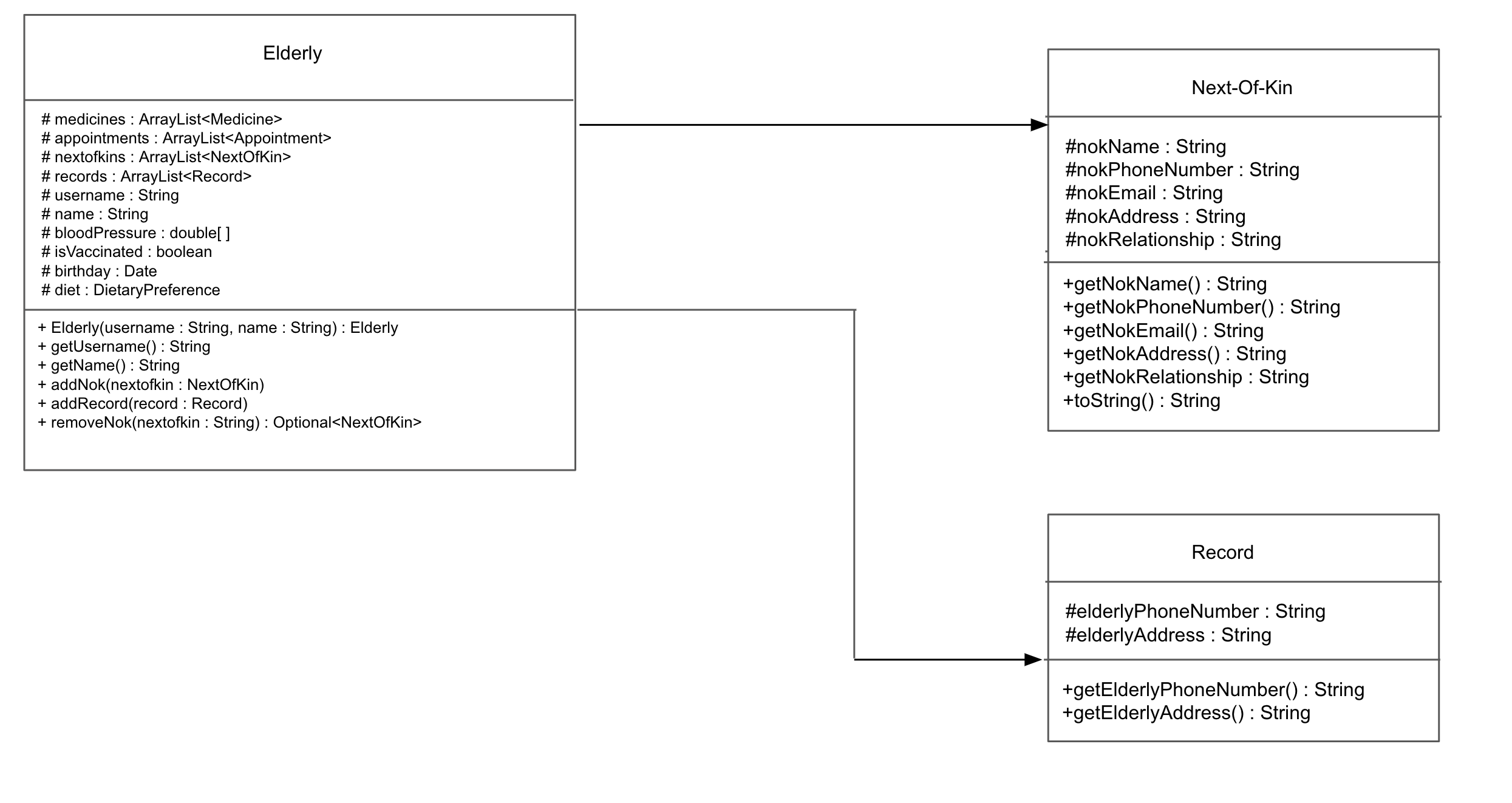 | ||
|
There was a problem hiding this comment. Same issue with the previous class diagram. The relationships between |
||
|
|
||
|
There was a problem hiding this comment. this is correct UML notation, the first diagram used in the guide can be edited to match this notation (although some standardisation is needed e.g. in |
||
| #### Interaction of Classes | ||
|
There was a problem hiding this comment. Would be good to add a sequence diagram here to summarise how the function works as the description is slightly lengthy. |
||
| `Elderly` class will interact with `Next-of-kin` class through the use of `addNok()` function. This function will | ||
|
|
||
|
There was a problem hiding this comment. unsure if this blank line is intended or not, but does not seem to serve any purpose and is quite abrupt |
||
| add and store the Next-of-Kin information into the given elderly. It is possible to store more than | ||
| one Next-of-Kin information per elderly, as the information will all be stored in an Array List. This is to | ||
| cater to the possibility that the elderly has more than one point of contact. Multiple points of contact is also | ||
| extremely useful for the user as it increases the possibility to reach an emergency contact and | ||
| ensure a higher sense of security for the elderly. | ||
| This Next-of-Kin information can be retrieved at any point by using the `viewNok()` function. | ||
|
|
||
|
|
||
| `Elderly` class also interacts with the `Next-of-Kin` class through the use of `removeNok()` function. This function | ||
| deletes the particular Next-of-Kin information stored in the `Elderly` class, as specified by the user. The Array List | ||
| will no longer reflect the deleted Next-of-Kin information, likewise `viewNok()` will not have this information stored as well. | ||
|
|
||
|
|
||
| Interaction of the `Record` class is also similar to the previous interaction. However, the elderly information is | ||
| now stored instead. Similarly, `addRecord()` function is called to store the details of the elderly and `viewRecord()` | ||
| is used to view the details that are stored. | ||
|
|
||
| #### Future Implementation and Considerations | ||
|
|
||
|
There was a problem hiding this comment. a short explanation of how exactly this can be implemented could be given (similar to proposed undo/redo feature in AB3 developer guide here) |
||
| `removeRecord()` function has not been implemented yet as it is deemed to be **not critical** in this current phase. | ||
| However, it is a large possibility that the elderly would have a change in their phone number and address. In this current | ||
| implementation, it is **still possible** for the user to input the new details, as the details are stored in an Array List. | ||
| However, it is not the most ideal solution as there might be too many details which can be confusing for the user. | ||
| Moreover, there is no indication to show which is the current details that is accurate. Hence, this function should be | ||
| implemented in the future to help improve the usability and convenience of the overall user experience. | ||
|
|
||
|
|
||
| ## Product scope | ||
| Hi, welcome to the Elderly in Your Hood. | ||
| This is a product that has been developed in order to empower service personnel. Service personnel now have a convenient | ||
| and organised method to store information about the elderly they are assisting in an elderly home. | ||
|
|
||
|
|
||
| ### Target user profile | ||
| It is for service staffs at the elderly home who works at a PC, | ||
| prefers typing, and wants to avoid the tedious tracking of details of each and every | ||
| elderly they are assisting. | ||
|
|
||
| {Describe the target user profile} | ||
|
|
||
| ### Value proposition | ||
|
|
||
| {Describe the value proposition: what problem does it solve?} | ||
|
|
||
|
|
||
| Helpers in elderly care homes are often flooded with information. Different elderly has different conditions, and require so many | ||
| methods of care. Traditionally, information are stored as hardcopy in the forms of placards are information books. | ||
| However, with our program, we plan to centralise the different information each elderly has, and allow the helper, a fast typer, | ||
| to add and retrieve elderly information with ease. This increases productivity. | ||
|
|
||
| ## User Stories | ||
|
|
||
| |Version| As a ... | I want to ... | So that I can ...| | ||
| |--------|----------|---------------|------------------| | ||
| |v1.0|helper|add elderly| keep track of the list of all elderly| | ||
| |v1.0|helper|store hospital appointment dates|keep track of all hospital appointment dates for each elderly| | ||
| |v1.0|helper|view hospital appointment dates|view all the hospital appointment dates for each elderly| | ||
| |v1.0|helper|store elderly medicine types|keep track of the medicine for each elderly| | ||
| |v1.0|helper|view elderly medicine types|ensure that the elderly will take the right medicine on time| | ||
| |v2.0|helper|categorise elderly by risk level|pay more attention to elderly of higher risk| | ||
| |v2.0|helper|add hospital information to medium and high risk elderly|store hospital information specific to the elderly| | ||
| |v2.0|helper|view hospital information to medium and high risk elderly|utilise hospital information during emergency| | ||
| |v2.0|helper|add conditions of medium and high risk elderly|to keep track of conditions specific to the elderly| | ||
| |v2.0|helper|view conditions of medium and high risk elderly|view the conditions of the elderly| | ||
| |v2.0|helper|add notes on care of medium and high risk elderly|so that other helpers can render assistance specific to the elderly| | ||
| |v2.0|helper|view notes on care of medium and high risk elderly|take notes on how to care for the elderly| | ||
| |v2.0|helper|add doctor information to high risk elderly|store doctor information specific to the elderly| | ||
| |v2.0|helper|view doctor information to high risk elderly|utilise doctor information during emergency| | ||
|
|
||
|
|
||
| ## Non-Functional Requirements | ||
|
|
||
| {Give non-functional requirements} | ||
| 1. The product is not required to ensure that the dosage of medicine keyed are safe. | ||
| 2. The product should work on both 32-bit and 64-bit system. | ||
| 3. This version of product does not allow for addition of hospital and doctors. | ||
|
|
||
| ## Glossary | ||
|
There was a problem hiding this comment. In general, the DG is well written but can be organised better (the introduction seems to be at the bottom instead of the top) and have a section for the overall architecture/flow of the app. Would also be good to have a table of contents for better navigability. There was a problem hiding this comment. Adding to the previous reviewer's feedback, your team could look into having more diagrams of different types such as sequence diagrams (currently only 2 diagrams that are both class diagrams) to show your UML and documentation skills. |
||
|
|
||
|
|
||


There was a problem hiding this comment.
Choose a reason for hiding this comment
The reason will be displayed to describe this comment to others. Learn more.
Maybe this section should be further down instead of being the first section, as the first section is usually a brief introduction of the app/overview of architecture.