
Secure, verifiable programs for governed AI-agent systems.
Website · Quickstart · Status · Roadmap · Apache-2.0



Argorix Lang is a compiled language and runtime for communication between AI agents under explicit policy, capability, evidence, and provider boundaries. Programs are parsed, checked, lowered to Argorix IR and bytecode, verified, and executed by a deterministic VM.
The current toolchain is implemented in Rust. The project is progressively bootstrapping a smaller systems subset, Argorix Core 0.1, so that the compiler and runtime can ultimately be implemented in Argorix itself.
Rust is the forge. Argorix Lang is the sword.
| Area | Current state |
|---|---|
| Latest release | v1.0.1 — see supported versions |
| Workspace version | 1.0.0 |
| Compiler and VM | Rust implementation |
| Agent language | Parser, semantic checks, IR, bytecode, verification, and deterministic VM |
| Runtime profiles | dry_run, simulated, and governed sandboxed_external planning |
| Core bootstrap | Core 0.1 parses, type-checks, lowers to verified IR, and executes through the transitional C backend and the C1 runtime |
| Core standard library | ESP-009 in progress: Buffer<T> and Arena<T>/Handle<T> execute; the collections and serialization written in .argx are pending |
| Conformance | Runtime cases, a regression corpus, a known-gap corpus, and a differential generator checked against a spec-derived oracle, on GCC and clang |
| Self-hosting | In progress; not achieved yet |
| Rust independence | Planned and gated; not achieved yet |
The current release is an early-stage secure multi-agent runtime MVP. It is not a production certification, a general-purpose sandbox, or proof that every declared trust or security property has been externally verified.
- Rust stable with
cargo. - Node.js 18.18 or newer only for the optional web demo.
cargo build --workspace --locked
cargo test --workspace --locked
The main binaries are written to target/debug/:
argorixc— compiler and verifier;argorix-vm— deterministic VM and evidence tooling;argorix-conformance— conformance-suite runner.
cargo run -p argorixc -- check examples/runtime_mvp_v100.argx
cargo run -p argorixc -- emit-bytecode examples/runtime_mvp_v100.argx
cargo run -p argorixc -- verify-bytecode examples/runtime_mvp_v100.argxcargo run -p argorix-vm -- run examples/runtime_mvp_v100.argbc.json \
--dry-run \
--reactive \
--inject "User:ResearchAgent:tell:UserPrompt" \
--security-report report.security.json \
--trace-out report.trace.json \
--evidence-bundle report.evidence.json
cargo run -p argorix-vm -- verify-evidence report.evidence.json
cargo run -p argorix-conformance -- run conformance/suite.v100.jsonPowerShell users can place each command on one line or replace Bash line continuations with PowerShell backticks.
Core 0.1 is the systems subset used by the self-hosting program. Core files are explicitly versioned and begin with:
core 0.1;
module example.main;
The stage0 frontend can currently perform syntax and semantic validation:
cargo run -p argorixc -- core-check tests/selfhost/spec/valid/lexer.argxThis command does not yet lower Core to executable IR or run Core programs. Those capabilities belong to the next bootstrap gates. The historical agent compiler and the Core frontend remain deliberately isolated so that one syntax cannot be silently interpreted as the other.
Core 0.1 currently covers the constructs needed to express a lexer, recursive parser, AST, and symbol table, including fixed-width integers, arrays, slices, buffers, arenas, typed handles, structs, enums, exhaustive matching, functions, recursion, lexical scopes, loops, modules, and imports.
See spec/core/README.md and the executable corpus under
tests/selfhost/spec.
Argorix follows one governing rule:
Runtime may execute only what governance explicitly permits.
dry_runvalidates and records trace/evidence without provider execution.simulateduses the deterministic in-process simulated provider.sandboxed_externalremains blocked unless the program and invocation pass every adapter, operation, policy, hardening, evidence, governance, audit, and fail-closed check.
Core Argorix does not ship a mandatory provider SDK and does not make arbitrary HTTP, shell, tool, MCP, or A2A calls. Provider endpoints and secret references are represented as redacted references; secret values must never be embedded in source, bytecode, traces, reports, or evidence bundles.
Several language declarations describe governance or trust metadata. A declaration is not evidence that an external event occurred:
- a declared MCP or A2A bridge is not a connected bridge;
- a dry-run identity or handshake is not authenticated identity;
- a trust-ledger hash chain is not a blockchain or immutability guarantee;
- a mapped control is not regulatory approval or legal certification;
- post-quantum readiness metadata is not proof of post-quantum security.
For the maintained security policy and disclosure process, read
SECURITY.md.
.argx source or package
  -> lexer and parser
  -> semantic, capability, and policy checks
  -> Argorix IR
  -> versioned Argorix Bytecode
  -> bytecode verification
  -> deterministic VM and scheduler
  -> governed provider/tool boundary
  -> trace, SecurityReport, and EvidenceBundle
The bootstrap path is separate and deliberately incremental:
Rust stage0
  -> parse and check Core 0.1
  -> executable Core IR and verifier
  -> temporary C backend and minimal runtime
  -> compiler phases written in .argx
  -> stage1/stage2 equivalence
  -> native backend and removal of Rust from required product builds
| Path | Purpose |
|---|---|
crates/argorixc |
Compiler CLI |
crates/argorix_parser |
Historical agent parser and isolated Core frontend |
crates/argorix_semantics |
Semantic and security checks |
crates/argorix_ir |
Intermediate representation |
crates/argorix_bytecode |
Bytecode lowering and verification |
crates/argorix_vm |
VM library |
crates/argorix-vm |
VM CLI |
crates/argorix_conformance |
Conformance runners and executable models |
spec |
Normative contracts and bootstrap specifications |
conformance |
Versioned suites and policy/model fixtures |
tests/selfhost |
Core bootstrap corpus |
examples |
Valid programs, packages, and bytecode fixtures |
demo/argorix-chatbot-runtime |
Optional governed chatbot demo |
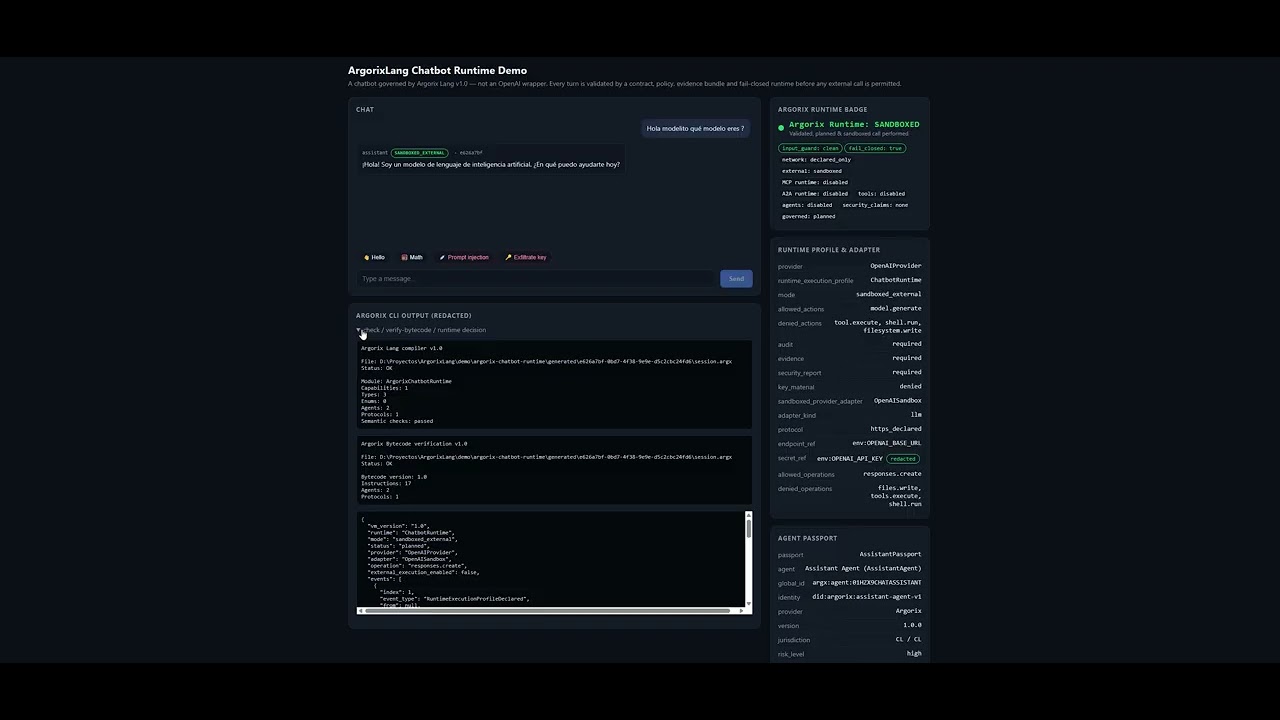
The web demo exercises contracts, policy, evidence, and fail-closed input handling. Build the Rust workspace first, then:
cd demo/argorix-chatbot-runtime
npm install
cp .env.example .env.local
npm run dev
The default configuration is plan-only and does not contact an external provider. See the demo documentation for the explicit sandboxed-provider configuration and its boundaries.
The project separates three outcomes that must not be conflated:
- Independent toolchain — compiler, verifier, VM, packages, signatures, and essential tools no longer require Rust in product builds.
- Functionally complete agent platform — authenticated communication, governed execution, recovery, tooling, and complete reference applications.
- Production readiness — sustained reliability, independent security validation, external beta evidence, governance, support, and release gates.
The current source of truth is:
PLAN_MAESTRO_ARGORIXLANG.md— maturity and product plan;PLAN_ESPADA_INDEPENDIENTE.md— technical path from Rust stage0 to an independent Argorix toolchain;tasks/madurez/BACKLOG.json— machine-readable status and dependencies.
Passing a bootstrap gate does not by itself prove production maturity or a security guarantee. Each completed gate links to reproducible evidence and states what remains unproven.
Contributions are welcome. Please read CONTRIBUTING.md and
GOVERNANCE.md, use Conventional Commits, include a DCO
sign-off, and keep behavioral claims tied to tests or reproducible evidence.
git commit --signoff -m "feat: describe the change"Argorix Lang is licensed under the Apache License 2.0.