Data Structure and Algorithms
- Hash Tables
- ASCII and UNICODE
- Binary Search
- Binary Search Trees
- Graphs
- Linked List
- Heap and Priority Queues
- Queues and Stacks
- Algorithms
- Bitwise Operations
- Iteration and Recursion
-
Single responsibilty principle: A class should have one and only one reason to change.
-
Open-closed principle: Objetcs should be open for extenstions, but closed for modifications.
-
Liskov substitution principle: Objects in a program should be replacable with instances of their subtypes without altering the correctness of the program.
-
Interface segregation principle: Many cilent-specific intererface is better than one general-purpose interface.
-
Dependency inversion principle: High level modules should not depend on low level modules, they should both depend upon abstractions.
Metrics used to descripe the efficiency of algorithms.
- T(n) is O(f(n)) = growth rate of T(n) <= growth rate of f(n) Upper Bound
- T(n) is Ω(f(n)) = growth rate of T(n) >= growth rate of f(n) Lower Bound
- T(n) is Θ(f(n)) = growth rate of T(n) == growth rate of f(n)f(n) Exact Bound
- T(n) is o(f(n)) = growth rate of T(n)T(n) < growth rate of f(n)f(n) Upper Bound that does not equal to
An in-place algorithm operates directly on its input and changes it, instead of creating and returning a new object.
Hash tables are used to associate key with values, each key should be able to compute a "hash function", which takes some or all information and digests it into a single integer.
Collision could be solved by using a linked-list.
Insertion, removal and lookup takes O(1) time, worst case takes O(n) time.
- Example: Use hash table to find all valid anagrams for a string:
- Sort the strings alphabetically.
- Add the sorted letters as a key in the table and the original word as one of the values in table.
- For strings from input, sort them and lookup the keys in the table, add if not exists or add to value if exists.
- Runs in O(n log n) for sorting and O(1) for lookup.
ASCII defines 128 characters,mapping to 0-127 characters. Unicode defines 221 characters. Unicode is a superset of ASCII, and the numbers 0–128 have the same meaning in ASCII as they have in Unicode.
Because Unicode characters don't generally fit into one 8-bit byte, there are numerous ways of storing Unicode characters in byte sequences, such as UTF-32 and UTF-8.
Let's assume we want to find a target number in an array of ints in nums:
def BinarySearch(self, startIndex, endIndex, nums, target):
  while startIndex + 1 < endIndex:
    mid = (startIndex + endIndex)//2
    if nums[mid] == target:
      return True
    elif nums[mid] > target:
      return self.BinarySearch(startIndex, mid - 1, nums, target)
    elif nums[mid] < target:
      return self.BinarySearch(mid + 1, endIndex, nums, target)
return False- A binary search tree is a binary tree in which all left decendents <= n <= all right decendents.
- BST Operations are usuallty O(log n). The length of a balanced BST is log n, worst case scenario is n.
- Complete binary tree: every level is filled except for perhaps the last level.
Binary Tree Traversals
-
In-order:
while node != None InOrderTraversal(node.left) visit(node) InOrderTraversal(node.right) -
Pre-order:
while node != None visit(node) PreOrderTraversal(node.left) PreOrderTraversal(node.right) -
Post-order:
while node != None PostOrderTraversal(node.left) PostOrderTraversal(node.right) visit(node) -
Min-heap: A complete binary tree where each node is smaller than its children. The root is the smallest element in the tree. Operations:
insertandextract_min, both takes O(log n) time. -
Max-heap: A complete binary tree where each node is larger than its children. The root is the largest element in the tree. Operations:
insertandextract_min, both takes O(log n) time.
Constructing a graph in an adjacency list format with defaultdict (imported from collections) when adding an edge for not existing vertex, this will not throw KeyError exception like the normal dictionary function, but will just create a new vertex along with this edge.
-
BFS for graphs: By implementing a queue and a
visitedlist to keep track of if the nodes of a vertex, starting with the source, BFS prints out the neighbouring nodes of the vertex and moves on to the next one by popping the queue. -
DFS for graphs: Using a recrusive function in the
DFS_helperfunction, we go down the vertex starting from the source and prints all the vertices that are not included in thevisitedlist.
- Loop detecting: Uses Floyd's hare-and-turtle algorithm, make a fast pointer that travels in two nodes at a time, and a slow pointer that travels one node at a time. If there exists a loop in the linked-list, fast and slow will meet.
                    Heap        PriorityQueue
1. Insert()         logn           logn
2. Delete()         logn           O(n)/ X
3. Pop()            logn           logn
4. Find()           logn             X
5. Modify()         logn             X
6. Min / Max        O(1)           O(1)
7. upper / lower     X              X
BFS uses queue, DFS uses stack.
LIFO. Used for tracing back to previous elements or operations.
class Stack:
    def __init__(self):
        self.stack = []
    def pop(self):
        if self.is_empty():
            return None
        else:
            return self.stack.pop()
    def push(self,val):
        return self.stack.append(val)
    def peak(self):
        if self.is_empty():
            return None
        else:
            return self.stack[-1]
    def size(self):
        return len(self.stack)
    def is_empty(self):
        return self.size() == 0
FIFO. Often used in BFS or implementing caches.
class Queue:
    def __init__(self):
        self.queue = []
    def enqueue(self,val):
        self.queue.insert(0,val)
    def dequeue(self):
        if self.is_empty():
            return None
        else:
            return self.queue.pop()
    def size(self):
        return len(self.queue)
    def is_empty(self):
        return self.size() == 0
Method 1 (By making push operation costly):
push(s, x)          // x is the element to be pushed and s is stack
  1) Enqueue x to q2
  2) One by one dequeue everything from q1 and enqueue to q2.
  3) Swap the names of q1 and q2
// Swapping of names is done to avoid one more movement of all elements
// from q2 to q1.

pop(s)
  1) Dequeue an item from q1 and return it.
Method 2 (By making pop operation costly):
push(s,  x)
  1) Enqueue x to q1 (assuming size of q1 is unlimited).

pop(s)
  1) One by one dequeue everything except the last element from q1 and enqueue to q2.
  2) Dequeue the last item of q1, the dequeued item is result, store it.
  3) Swap the names of q1 and q2
  4) Return the item stored in step 2.
// Swapping of names is done to avoid one more movement of all elements
// from q2 to q1.
Method 1 (By making enQueue operation costly)
enQueue(q, x)
  1) While stack1 is not empty, push everything from stack1 to stack2.
  2) Push x to stack1 (assuming size of stacks is unlimited).
  3) Push everything back to stack1.

deQueue(q)
  1) If stack1 is empty then error.
  2) Pop an item from stack1 and return it
Method 2 (By making deQueue operation costly)
enQueue(q,  x)
  1) Push x to stack1 (assuming size of stacks is unlimited).

deQueue(q)
  1) If both stacks are empty then error.
  2) If stack2 is empty
       While stack1 is not empty, push everything from stack1 to stack2.
  3) Pop the element from stack2 and return it.
-
Sorting on O(n). Uses an auxiliary array that holds the number of elememts that equal to the index of Index_Arr. Based on the number of entires specified in the Index_Arr, the Out_Arr stores the sorted array in an ascending order.
-
In-place and non-in-place methods included. Sorts in O(n log n).
-
An efficient algorithm for sorting a small number of elements. Time complexity: Best O(n), Worst: O(n2).
-
A divide, conquer and combine recursive sorting algorithm. Time complexity: O(n log(n)).
-
- Explore each neightbour before exploring any children.
- Preferred if want to find shortest path between two nodes, as we wish to stay close to the starting node as close as possible.
- Can be implemented using recursive or queue.
-
- Start at root or selected node and explore each branch completely before moving on to next branch.
- Preferred if want to visit all nodes in graph. Simpler compared to BFS.
- Tree Traversals mentioned above are a form of DFS.
Two's Complement: Take the inverse of the binary form and add 1. In Python:
- x << y => x shifting to the left by y places (multiplying by 2y).
- x >> y => x shifting to the right by y places (dividing by 2y).
- x & y => bitwise AND.
- x | y => bitwise OR.
- x => returns the complement of x. (-x - 1).
- x ^ y => bitwise XOR.
Both perform the same kinds of tasks: Solve a complicated task one piece at a time, and combine the results.
-
Iteration: keep repeating until a task is “done”.
- e.g., loop counter reaches limit, linked list reaches null pointer, instream.eof() becomes true.
-
Recursion: solve a large problem by breaking it up into smaller and smaller pieces until you can solve it; combine the results.
- e.g., recursive factorial funtion
- If the URL contains a domain name, the browser first connects to a domain name server and retrieves the corresponding IP address for the web server.
- The web browser connects to the web server and sends an HTTP request (via the protocol stack) for the desired web page.
- The web server receives the request and checks for the desired page. If the page exists, the web server sends it. If the server cannot find the requested page, it will send an HTTP 404 error message.
- The web browser receives the page back and the connection is closed.
- The browser then parses through the page and looks for other page elements it needs to complete the web page. These usually include images, applets, etc.
- For each element needed, the browser makes additional connections and HTTP requests to the server for each element.
- When the browser has finished loading all images, applets, etc. the page will be completely loaded in the browser window.
Each process has one or more threads, the processor switches between threads quickly, only one thread is running at given time.
-
Mutex
An OS program object (counter) to allow multiple program thread to take turns sharing the same resource.
- Usually an int = 1.
- When thread locks mutex, mutex -= 1, when thread unlocks mutex, mutex += 1.
-
Semaphore
An OS program object (counter) that may start off greater than 1. A binary semaphore is a mutex.
-
Number of threads allowed to access resource at once = starting int of semaphores.
-
Support "wait" ("lock") and "signal" ("unlock") operations.
-
Monitor
A user-defined object/class designed for multiple thread access. Special type of semaphore. If one thread is currently executing a member function of the object then any other thread that tries to call a member function of that object will have to wait until the first has finished.
Mutex Structures:
- Single-core:
bool Locked = False      // determine if lock is locked/unlocked
queue waitlist           // list of process/threads to be run
- Multi-cores:
int spinlock            // a lock which causes a thread trying to acquire it to simply wait in a loop ("spin") while                                     repeatedly checking if the lock is available.
bool Locked = False
queue waitlist
Deadlocks
A situation when a thread is waiting for an object lock that another thread holds, and this second thread is waiting for the an object that the first thread holds. They both remain waiting forever. This can happen under the following situation:
- Mutual Exclusion: There a limit access to resources.
- Hold and Wait: Processes already holding a resource can request additional resources, without relinquishing their current resources.
- No Preemption: One process cannot force another process to remove their access to the resource.
- Circular Wait: Two or more processes form a circular chain where each process is waiting on another resource in the chain. Deadlock prevention: Locks ranking.
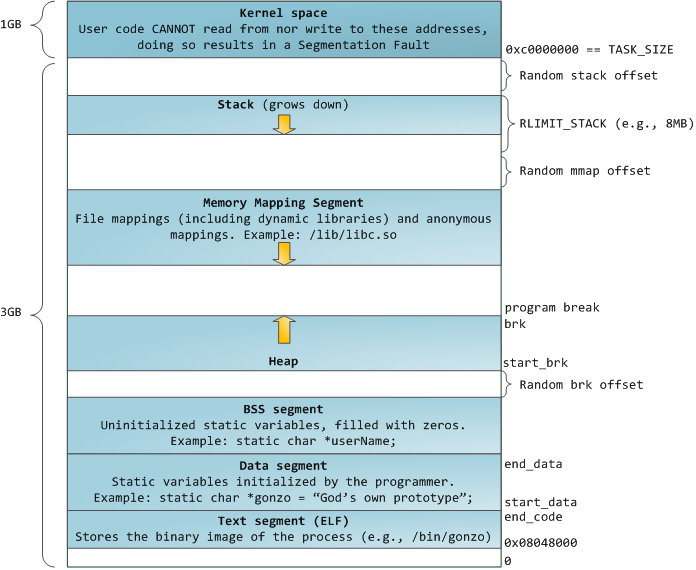

Stack is used for static memory allocation and heap for dynamic memory allocation, both stored in the computer's RAM .
Use stack if exactly how much data needed to allocate is known before compile time and it is not too big. Use heap if don't know exactly how much data needed at runtime or need to allocate a lot of data.
- Stack
The most straightforward way LIFO stacks may be programmed into conventional computers is to allocate an array in memory, and keep a variable with the array index number of the topmost active element. Blocks of memory locations can be allocated and a pointer (%esp) with the actual address of the top stack element is used to maintain and keep track of the topmost element.
A very important property of stacks is that, in their purest form, they only allow access to the top element in the data structure. They allow recursive invocations of procedures without risk of destroying data from previous invocations of the routine.
Variables allocated on the stack are stored directly to the memory and access to this memory is therefore fast, and it's allocation happens when the program is compiled.
The stack is always reserved in a LIFO order, the most recently reserved block is always the next block to be freed. This makes it really simple to keep track of the stack, freeing a block from the stack is nothing more than adjusting one pointer.
- Heap
Variables allocated on the heap have their memory allocated at run time and accessing this memory is a bit slower, but the heap size is only limited by the size of virtual memory . Element of the heap have no dependencies with each other and can always be accessed randomly at any time. You can allocate a block at any time and free it at any time. This makes it much more complex to keep track of which parts of the heap are allocated or free at any given time.
- In a multi-threaded situation each thread will have its own completely independent stack but they will share the heap. Stack is thread specific and heap is application specific. The stack is important to consider in exception handling and thread executions.
The following content is taken out from Operating Systems: Three Easy Pieces by Remzi H. Arpaci-Dusseau and Andrea C. Arpaci-Dusseau.
An error caused when not allocating memory for some routines calls which requires malloc().
A related error for not allocating enough memory. In some cases this is harmless, perhaps overwriting a variable that isn’t used anymore. In some cases, these over- flows can be incredibly harmful, and in fact are the source of many security vulnerabilities in systems.
Happens when memory that is allocated, then unused but never freed. The device should work indefinitely, without ever needing a reboot, but this will slowly leak memory eventually leads to running out of memory, at which point a restart is required.
When a particular computer program tries to use more memory space than the call stack has available.
Happens during excessively deep or infinite recursion, in which a function calls itself so many times that the space needed to store the variables and information associated with each call is more than can fit on the stack. Can also happen when large stack variables are allocated.
- Time Complexity Cheat Sheet
- HTML - Online Regex Testing.
- Python regex cheatsheet
- How does the internet works?
- Programming Behavior Section in Daniel's blog.
- Python 3 Pattern, Recipe and Idioms