
We are creating our own society. A place citizens have FULL control, have their own MONEY, have AI that serves THEM, and CONTROL together. Unstoppable by design, self-replicating, self-hosted, self-evolving, and human oversight with democratic governance. Well, that is our Utopian dream! It now runs and empowers a network of seedboxes.
Our work contains several novelties:
- ⏩ Streaming Torrents. Quality streaming in P2P, competitive to Tiktok/Youtube/Netflix {warning: still on separate branch. Streaming GUI requires QT, decoder, Javascript bloat 🥹}.
- 🪞 Self-replication. Servers that can buy other servers using Bitcoin. Fully automated cloning of servers.
- ⚡ Trust. First trust framework and true Peer-to-Peer agent communication fabric. No DNS, no central control.
- 🧑🚒 AI models in a real-time competition for survival of the fittest using multi-arm-bandit and model score gossip.
- 👓 Find information using decentralized relevance ranking
- 🥇 First decentralized voting system. Your place, your control, your vote.
- 🥼 User-driven self-evolution. The emergent voting behavior is that users drive the roadmap using democracy. No lawyer or company can stop the will of the people.
Download .EXE : https://github.com/Tribler/superorganism-experiment/releases
Together with Szeged University we deployed fully decentral machine learning in 2012. Completely useless, due to lack of compute, lack of data, and our lack of experience. Last year we got decentral learning for search operational plus the business model.
Strong AI is a natural monopoly. Citizens should control AI. We want control of AI to be as simple as possible. Superorganism has a system where you can vote for new features. For example:

Our superorganism is an exploratory experiment for self-hosted and self-improving systems under direct human control. It is a decentralized system ability to create seedboxes, vote on systems changes, and donate GPU resources for decentralised AI. It runs on our machines, but it's complex stuff. Frontpage screenshot below with 1) torrent management, 2) self-replicating server fleet overview, 3) voting part, and 4) autoresearch (shown page). Our Eternal Autoresearch is inspired by "Darwin Gödel Machine: Open-Ended Evolution of Self-Improving Agents". But we rely our Bitcoin payments for real human developers, so more classical collective intelligence (until AI agents become better at coding).

Superorganism is the joint work of professors, post-docs, phd students and master students (i.e. the ones doing the real work!) at Delft University of Technology and academic partners. Algorithms and key components are documented here.
| Algorithm | Superorganism algorithm extensive documentation |
|---|---|
| SurvivalRank | Evolutionary survival of fittest algorithm using decentralized multi-arm bandits |
| FuSST | Social Capital Accounting for trust with Sybil resilience |
| TwoStepDemocracy | TwoStepDemocracy: prototyping of self-evolving, democratic, and decentralized systems {#8812} |
| SelfReplicate | Self-replicating seedbox servers using programmable money |
| DelftClaw | Infrastructure for decentralized OpenClaw semantic search agents: identity, trust, communication, and self-replication (5 bsc students, needs integration) |
Now that the basic components are all operational, we're working on integration.
- A million URLs with creative commons content on Youtube + download tooling + Bittorrent autoseeding
- Decentralized survival-of-fittest learn-to-rank algorithm.
- Semantic overlay (ToDo integrate our decentralized semantic overlay)
- Search engine (ToDo integrate our decentralized learn-to-rank AI algorithms)
- Voting and use your Bitcoin wallet to stake your identity (ToDo move from testnet to mainnet)

Qt UI resources are listed in the ui/resources/ directory, including icons, fonts, images, and the resource manifest. They must be converted using the PySide6 resource compiler. Run the following command after adding new UI resources:
pyside6-rcc ui/resources/resources.qrc -o ui/resources/resources_rc.py- Various overlay messages for vote exchange and object synchronization
- Software developers get paid for pull request using Bitcoin with special commitments flags ALL|ANYONECANPAY.
- local SQLite is used for simple local storage
- Different learn-to-rank models are deployed in the network and performance score is determined (NDCG)
- decentralized multie-arm bandit ensures survival-of-the-fittest and cleaning of low-performance variants.
Our new graph-based trust algorithm is not integrated into the prototype. This is a Sybil detection reference implementation. The FuSST algorithm fuses a trust graph G_T (the platform follow or interaction graph) with a behavioural graph G_B (a mutual k-NN graph over five platform-agnostic behavioural features) and runs belief propagation (SybilSCAR and SybilHP variants) over the combined structure, optionally seeded with a logistic-regression prior. This repository contains the complete code to reproduce every table and figure in the thesis across four labelled datasets (Cresci-2015, Cresci-2017, TwiBot-20, TwiBot-22) plus the Twitter-270k engine-validation benchmark.
This is the self-replication part. Any server with a bitcoin wallet and our scripts can buy another server, clone itself, move money to clone, and then this clone can buy more servers. This has proven to be very difficult to move from lab prototype into production-level code. We have been working since 2016 on this. We got generational Q-learning running. See our 2017 running code in PyPi called CloudOmate where you can buy a VPS fully scripted. No account creation, no bank account validation, no passport upload, no wait period, simply a $100 deposit against abuse. Basis for our self-replication:
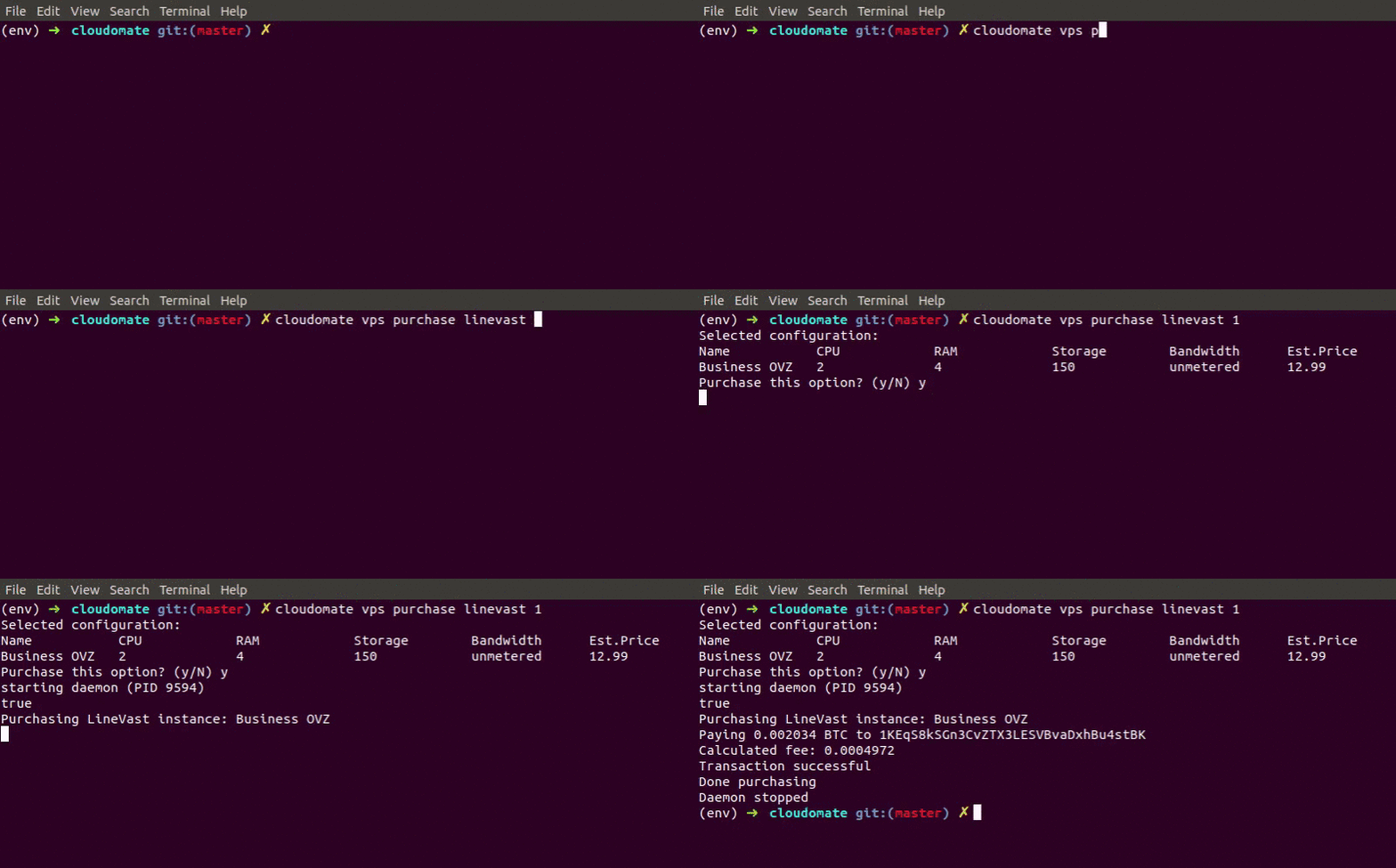
Autonomous VPS provisioning system using Bitcoin payments and SporeStack API. Deploys Mycelium a BitTorrent seedbox orchestrator for Creative Commons content. What it does:
- Seeds content via BitTorrent (libtorrent)
- Auto-updates from central server GitHub (yes, we want self-hosting! Apply for phd position on this) and restarts on code changes
- Broadcasts seeded content to IPV8 peers for health monitoring
This project uses a local Bitcoin Core regtest node for development and integration testing. Regtest is a private blockchain intended for testing. It does not connect to mainnet, and blocks can be mined on demand.
The script scripts/regtest.sh automates the local setup by:
- creating a dedicated regtest data directory inside the project
- generating a bitcoin.conf
- starting bitcoind
- creating or loading a wallet
- mining initial blocks so the wallet has spendable funds
- exposing simple commands for status, reset, mining, and demo transactions
The script requires:
- bash
- bitcoind (part of Bitcoin Core)
- bitcoin-cli (part of Bitcoin Core)
- jq (for JSON parsing)
brew install bitcoinbrew install jqThe script stores all regtest data inside the repository:
.bitcoin/regtest-demo/
The script supports a few environment variables, but all have sensible defaults.
| Variable | Default | Description |
|---|---|---|
BITCOIND_BIN |
bitcoind |
Path to the bitcoind binary |
BITCOINCLI_BIN |
bitcoin-cli |
Path to the bitcoin-cli binary |
DATA_DIR |
./.bitcoin/regtest-demo |
Regtest data directory |
WALLET_NAME |
demo |
Wallet name used for testing |
RPC_USER |
demo |
RPC username |
RPC_PASSWORD |
superorganism |
RPC password |
RPC_PORT |
18443 |
Regtest RPC port |
P2P_PORT |
18444 |
Regtest P2P port |
HOST |
127.0.0.1 |
Host interface for the node |
The script supports the following commands:
scripts/regtest.sh start
scripts/regtest.sh stop
scripts/regtest.sh reset
scripts/regtest.sh status
scripts/regtest.sh mine [n]
scripts/regtest.sh send <address> [amount] [op_return_hex]
scripts/regtest.sh treasury-address
scripts/regtest.sh sign-psbt <psbt_base64>| Command | Description |
|---|---|
start |
Starts the regtest node, creates the config file if needed, loads or creates the wallet, and ensures the wallet is funded. On first startup, the script mines 101 blocks. This is necessary because coinbase rewards must mature before they become spendable. |
stop |
Stops the running regtest node. |
reset |
Deletes the local regtest blockchain and wallet state, then starts from a clean environment. This is useful for repeatable integration tests. |
status |
Prints basic blockchain and wallet state. |
mine |
Mines one or more new regtest blocks. This is especially useful for confirming transactions during testing. |
send |
Sends a demo transaction from the local wallet. |
treasury-address |
Prints the address of the treasury. This is useful for funding the wallet from external tools or for testing incoming transactions. |
sign-psbt |
Signs a base64 PSBT with the local demo wallet using ALL|ANYONECANPAY and prints the signed PSBT. This is intended for the local funding-pledge flow. |
DISCLAIMER: this is throw-away code