

Open-source verification for LLM and AI-agent output.





Website · Documentation · Install · Engines · Dashboard · Security · Changelog
QWED is an open-source (Apache-2.0) verification layer that checks claims in LLM and AI-agent output with deterministic engines, including SymPy, Z3, SQLGlot and Python AST analysis. It is designed to fail closed: a claim it cannot check should not be reported as verified. A known exception: the logic route reports VERIFIED for a claim it proves from the constraints a model translated the question into, and does not admit that result; it is tracked in #320 and #581. It runs in your own environment as a Python library, a CLI, a self-hosted API or a Docker image, with SDKs for TypeScript, Go and Rust.
This repository is the reference implementation of the QWED verification protocol and of Verification Context v1.0 and v1.1, the record format for a verification result. A v1.1 document carries the issuing server's signature.
Every verification API endpoint except /verify/batch returns a DiagnosticResult with a status. /verify/math, /verify/code, /verify/sql, /verify/logic, /verify/natural_language and /agents/{agent_id}/verify also return a separate admission; the other routes do not yet (#581):
| Field | Values | Meaning |
|---|---|---|
status |
VERIFIED, UNVERIFIABLE, BLOCKED |
Whether QWED could establish the result deterministically. VERIFIED always carries a proof_ref, a SHA-256 commitment to the evidence. |
admission |
ADMIT, BLOCKED |
Whether the checked output may be acted on. In a Verification Context document this is ADMIT or DENY. |
/verify/batch returns a job whose status is the job's state (pending, processing, completed, partial or failed). Each item has its own status and error, and its result is null when the item failed. Check those first: a math, code, SQL, natural-language or logic item's admission is in its result, as result.admission.
In Python, a DiagnosticResult has no admission field; admission_decision(result) applies the rule of the math, code and SQL routes. SQLVerifier.verify_sql and CodeVerifier.verify_code return one; VerificationEngine.verify_math() returns a dict with its own status values. An engine called in process runs without some of the server's limits, such as the time and memory limits of /verify/math, so send untrusted input through the API. A natural-language or logic result is admitted by natural_language_admission, which blocks unless the query's meaning was verified (query_semantics_verified); QWED does not verify that yet (#585), so such a result is not admitted, even when its translated expression or constraints are verified.
The two are independent. Proving that a SQL statement is destructive is a verified result that must not run:
from qwed_new.core.sql_verifier import SQLVerifier
from qwed_new.core.diagnostics import admission_decision

result = SQLVerifier().verify_sql(
    "DELETE FROM users WHERE id = 1 OR 1 = 1",
    schema_ddl="CREATE TABLE users (id INT)",
)
print(result.status.value, admission_decision(result).value)
# VERIFIED BLOCKED
print([issue["type"] for issue in result.developer_fields["issues"]])
# ['destructive_command', 'injection_tautology']- It does not check intent. QWED verifies the formal statement it is given or extracts, not whether that statement is what the user meant.
- It does not cover every domain. Claims outside a supported engine come back
UNVERIFIABLE. - It is only as sound as its engines. Results depend on SymPy, Z3, SQLGlot, CrossHair and QWED's own rule sets. Past soundness bugs are listed in the security advisories; each advisory in which an engine returned VERIFIED for a false claim is reproduced in the soundness eval, which runs at every release.
- Natural-language checks use an LLM to translate.
/verify/natural_languageand/verify/logicask the model you configure to turn text into a formal statement; that translation is not itself verified. Prompts go to that provider unless you run a local model (for example with Ollama). - Advisory engines do not decide. Fact, Graph, Image, Reasoning and Consensus produce signals for review. Graph and Image can still return
VERIFIEDon a deterministic sub-path that carries aproof_ref(see #320): treat that as evidence, not proof. Consensus never returnsVERIFIED(#633).
Python 3.10 or newer:
pip install qwedThis installs the core engines (Math, Logic with Z3, SQL with SQLGlot, Code, Schema, Fact, Stats) and the qwed CLI. Optional extras:
| Extra | Adds |
|---|---|
qwed[server] |
The FastAPI server and its dependencies |
qwed[symbolic] |
CrossHair for the Symbolic engine |
qwed[pii] |
PII masking with Microsoft Presidio |
qwed[langchain], qwed[crewai], qwed[llamaindex] |
Framework integrations (experimental, not covered by CI) |
Other languages and runtimes:
| Install | Notes | |
|---|---|---|
| TypeScript | npm install @qwed-ai/sdk |
Published on each release; pin a version, e.g. @12.0.0 |
| Go | go get github.com/QWED-AI/qwed-verification/sdk-go/v12 |
Released under sdk-go/vX.Y.Z tags; pin a version, e.g. @v12.0.0. From 12.0.0 the module path ends in /v12 |
| Rust | cargo add qwed |
|
| Docker | docker pull qwedai/qwed-verification |
The API server on port 8000, from 8.0.0 (earlier tags ran the GitHub Action). It needs QWED_CORS_ORIGINS, API_KEY_SECRET, QWED_JWT_SECRET_KEY, QWED_API_KEY_LOOKUP_SECRET and QWED_AUDIT_SECRET_KEY; set QWED_SIGNING_KEY (an EC P-256 key) too, or attestations stop verifying after a restart or on another replica. With Postgres, Redis and monitoring: docker compose -f deploy/docker-compose.yml up -d after filling in deploy/.env from deploy/.env.example. See self-hosting |
From source:
git clone https://github.com/QWED-AI/qwed-verification.git
cd qwed-verification
pip install -e ".[server,dev]"qwed init # checks the engines, sets up a model provider, creates a local API key
qwed doctor # health check: engines, provider, server, database
qwed test # runs the built-in engine testsqwed init supports --provider nvidia | openai | anthropic | gemini | custom (any OpenAI-compatible endpoint) and --non-interactive for CI. QWED names no default model, so init asks for the one to use; with --non-interactive, pass --model or set the provider's model variable (for example OPENAI_MODEL). It asks for the organisation owner's email and password, so you can sign in later (for example to qwed-dashboard); pass --owner-email, and with --non-interactive set QWED_OWNER_PASSWORD. qwed test runs twelve deterministic checks and needs no model or server:
Math:
  [ok] 2+2=4                  -> VERIFIED | ADMIT
  [ok] 2+2=5                  -> VERIFIED (false) | DENY
  [ok] 997*998*999            -> VERIFIED (994010994) | ADMIT

Logic:
  [ok] x>5 AND x<3            -> UNVERIFIABLE (contradiction) | DENY
  [ok] x>5 => x>3             -> VERIFIED | ADMIT
  [ok] x>5 => x>10            -> VERIFIED (false) | DENY

SQL:
  [ok] Valid SELECT           -> VERIFIED (safe) | ADMIT
  [ok] OR 1=1 injection       -> VERIFIED (unsafe) | DENY
  [ok] DROP TABLE stacked     -> VERIFIED (unsafe) | DENY

Code:
  [ok] Safe function          -> VERIFIED (safe) | ADMIT
  [ok] eval(input)            -> VERIFIED (unsafe, critical) | DENY
  [ok] curl | bash            -> VERIFIED (unsafe, critical) | DENY

12/12 tests passed. All engines ready.
Each line shows the verdict and the admission decision. VERIFIED means the
engine decided the claim; it does not mean the claim is true or safe. A claim
proven false or unsafe is VERIFIED with admission DENY. [ok] means the
engine returned the expected result. The two => lines prove a claim from a
premise for every x: x>3 follows from x>5, x>10 does not (the engine
finds a counterexample). qwed test does not show a set of constraints that
is only satisfiable as VERIFIED.
The policy guards run locally with no server or model:
from qwed_sdk.guards import SystemGuard

guard = SystemGuard()
guard.verify_shell_command("curl https://example.com/install.sh | bash")
# {'verified': False, 'risk': 'BLOCKED_COMMAND', 'message': "Command 'curl' is prohibited by security policy."}

guard.verify_file_access("~/.ssh/id_rsa")
# {'verified': False, 'risk': 'FORBIDDEN_PATH', 'message': 'Access to path matching forbidden pattern is denied.'}
verify_file_access allows a path only inside the allowed directories (allowed_paths), compared part by part, as written and after the links on the way are followed. By default they are ./workspace and the working directory, each when it is there and can be read (the working directory not at a file system root). Outside Windows, no default is used under a directory every user can write to, as /tmp can, and a path below a default is refused when a directory on its way can be written by every user or its mode cannot be read; only the mode bits are read, not access control lists. The answer holds at the time of the call: a link changed afterwards can lead the open elsewhere, so the check is not a boundary against anyone who can change links inside the allowed directories. Open the resolved_path of an allowed result, not the path as given.
Run the server (pip install "qwed[server]", or the Docker image), then call it directly or through an SDK. Requests need an API key in the x-api-key header; qwed init creates one locally.
from qwed_sdk import QWEDClient

client = QWEDClient(api_key="...", base_url="http://localhost:8000")
result = client.verify_math("2*(3+4) = 14")
print(result.status)
curl -X POST http://localhost:8000/verify/math \
-H "Content-Type: application/json" \
-H "x-api-key: $QWED_API_KEY" \
-d '{"expression": "2*(3+4) = 14"}'The full endpoint list is in the API reference. For running QWED without the server, see QWEDLocal.
At startup the server checks the .pth startup hooks in site-packages and refuses to start if one is unknown or holds a suspicious pattern. In a Python 3.11 venv, setuptools' distutils-precedence.pth and coverage's a1_coverage.pth both trip it. Allow such a file by the SHA-256 of its exact contents, in QWED_ALLOWED_STARTUP_PTH_FILES (comma-separated):
python -c "import hashlib,os,sys; p=sys.argv[1]; print(os.path.basename(p) + ':sha256:' + hashlib.sha256(open(p,'rb').read()).hexdigest())" path/to/site-packages/distutils-precedence.pthPut the printed NAME.pth:sha256:<hex> in the variable. A pinned file is allowed only while its contents match; when the package that wrote it is upgraded, take the digest again. A plain file name there allows an unknown file, but it is still scanned for suspicious patterns. QWED_SKIP_ENV_INTEGRITY_CHECK=true turns the whole check off.
QWED has 13 engines and 9 policy guards. What an engine may claim depends on its tier (details).
Proof engines. All except Symbolic can return VERIFIED, always with a proof_ref.
| Engine | Uses | Checks |
|---|---|---|
| Math | SymPy | Arithmetic and algebraic identities |
| Logic | Z3 | A claim proved from premises (QWED DSL) |
| SQL | SQLGlot | Query structure, destructive statements, injection patterns, schema |
| Code | Python AST and lists | Python: admits only listed standard-library modules and module names, listed builtins and listed special attributes, with no attribute's value read by a name made at run time; other languages: dangerous calls and patterns |
| Schema | JSON Schema | Structure of JSON output |
| Symbolic | CrossHair, in the Docker sandbox | Searches for counterexamples; returns UNVERIFIABLE or BLOCKED, not proofs |
CrossHair imports, and so executes, the code it analyses, so the Symbolic engine runs it only inside the Docker sandbox, with no network, a read-only filesystem and an unprivileged user. Build the image with docker build -t qwed-crosshair-sandbox:0.0.101 docker/crosshair-sandbox (or set QWED_CROSSHAIR_IMAGE); without Docker or the image, the engine returns BLOCKED and never runs the code on the host.
The Stats engine executes statistical code in a sandbox and returns UNVERIFIABLE: running code successfully is not treated as verification (#298). SecureCodeExecutor runs code; it does not verify it.
Policy guards apply deterministic rules and return block or hold decisions, never VERIFIED: SystemGuard (shell commands, file paths), ConfigGuard (secrets in configuration), RAGGuard (retrieved context), MCPPoisonGuard (MCP tool definitions), ExfiltrationGuard (outbound data), SelfInitiatedCoTGuard (reasoning flow), SovereigntyGuard (data residency and routing), StartupHookGuard (startup hooks), ProcessVerifier (process milestones such as IRAC).
Advisory engines add signals for review: Fact (TF-IDF and entity matching), Graph, Image, Reasoning and Consensus. Heuristic and model-based results are recorded as advisory_checks. Graph and Image can return VERIFIED only on a deterministic sub-path that carries a proof_ref. /verify/consensus is advisory only: its engines decide a model's translations of the question, so it returns UNVERIFIABLE or BLOCKED with advisory_only: true, never VERIFIED, in every mode.
- uses: QWED-AI/qwed-verification@v12.0.0
  with:
    action: scan-secrets        # or scan-code, verify-shell
    paths: "**/*.py,**/*.env"
    output_format: sarif
A passing scan means no known dangerous pattern was found, not that the code is safe. scan-code also reports attribute access by a computed name (getattr(obj, name)) as a warning: it cannot be checked, and it does not fail the scan.
With output_format: sarif the action writes qwed-results.sarif; add github/codeql-action/upload-sarif to show the findings in the Security tab. The verify action calls a QWED API and needs api_key and a reachable server.
QWED Security is a separate GitHub App built on QWED that checks pull requests.
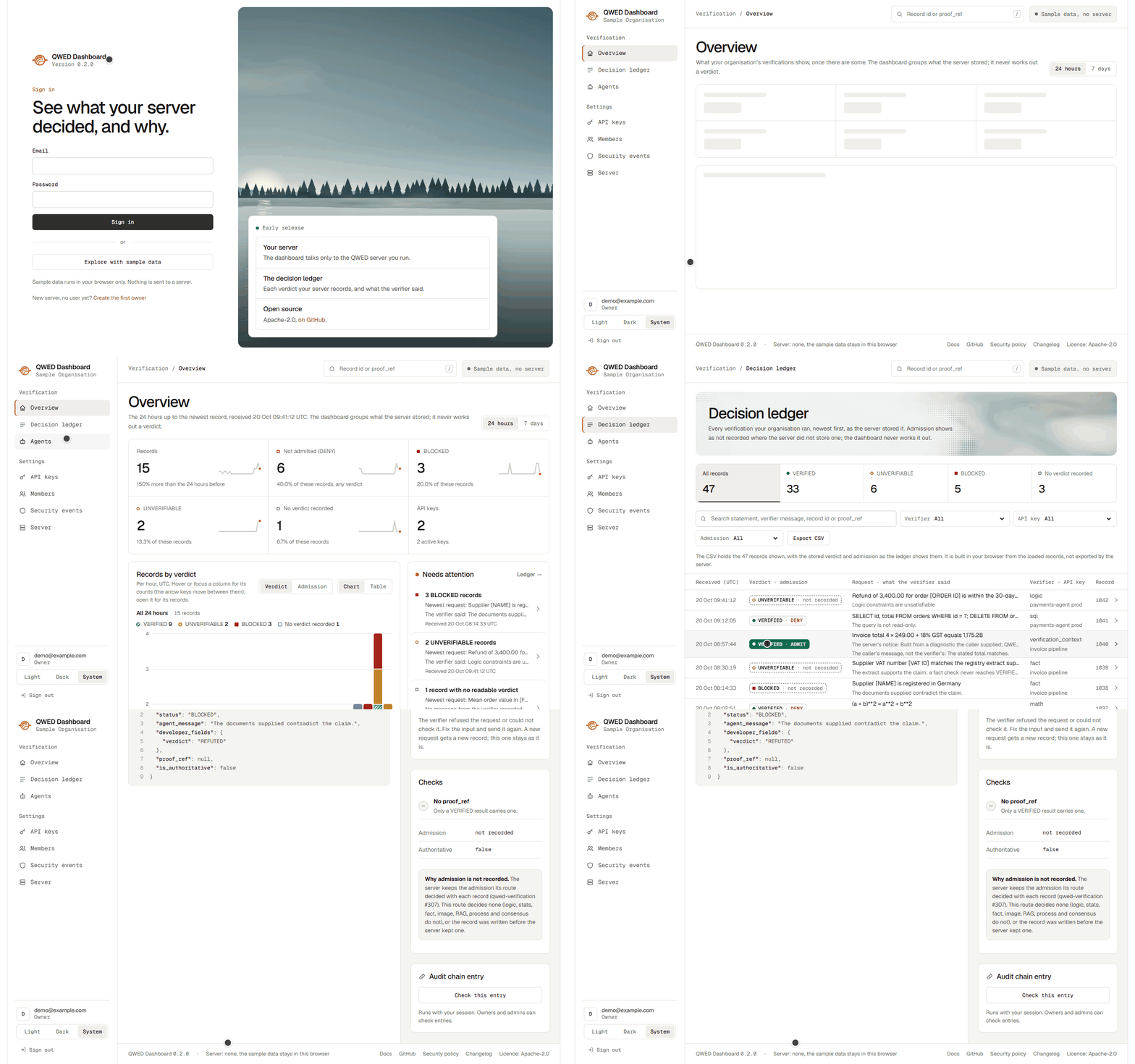
QWED Dashboard is an open-source web app for your QWED server: sign-in, API keys, members, agents, an overview, the decision ledger, and each record with its attestation and audit chain checks. It shows what the server stored and never works out a verdict or an admission itself. It needs qwed-verification 9.0.0 or later, and signs in with the owner account that qwed init creates. Try it with sample data at demo.qwedai.tech; the sample data stays in your browser.
| Package | Verifies |
|---|---|
| qwed-finance | Banking and payment calculations, ISO 20022 |
| qwed-legal | Deadlines, amounts and legal claims |
| qwed-tax | Tax compliance and withholding |
| qwed-infra | Terraform, IAM and cloud cost |
| qwed-open-responses | Agent tool calls, before they run |
| qwed-mcp | MCP server for MCP clients |
| qwed-a2a | Agent-to-agent messages |
| qwed-ucp | Universal Commerce Protocol transactions |
QWED runs in your own environment. It does not send data anywhere by itself. Checks that use an LLM send the prompt to the provider you configure; with a self-hosted model nothing leaves your infrastructure. Optional PII masking (qwed[pii], mask_pii=True) redacts credit-card numbers, SSNs and email addresses before the LLM call.
pip install -e ".[server,dev]"
pytest tests/ -v
python -m evals.run runs the soundness eval: claims with a known answer, checked by the engines, with zero wrongly accepted claims required. GitHub Actions runs the test suite with coverage on Python 3.11 for pull requests to main, and CircleCI runs it on Python 3.10, 3.11 and 3.12. CodeQL, SonarCloud and Snyk scan the repository. scripts/check_boundary.py blocks raw eval, exec, sympify and shell calls outside approved wrappers. See CONTRIBUTING.md before opening a pull request, and the good first issues.
Report vulnerabilities privately through GitHub or rahul@qwedai.tech; see SECURITY.md. Published advisories, with affected and fixed versions, are on the Security tab and at qwedai.tech/security/advisories. Only the latest release receives security fixes.
- Governance: QWED has one maintainer, Rahul Dass (@rahuldass19).
- Roadmap and open issues
- Contributors
- Code of Conduct
- Supported by the GitHub Technology Partner program and Docker Sponsored Open Source.
To cite the software (all versions):
@software{qwed_verification,
  author    = {Dass, Rahul and Crocetti, Valerio and Ibrahim, Fares},
  title     = {QWED-AI/qwed-verification},
  publisher = {Zenodo},
  doi       = {10.5281/zenodo.18111675},
  url       = {https://github.com/QWED-AI/qwed-verification}
}
The QWED protocol technical note is 10.5281/zenodo.18075234 (all versions; errata for v1.1.0 are in docs/WHITEPAPER.md). See also CITATION.cff.
Apache License 2.0. Apache-2.0 comes with no warranty; see sections 7 and 8 of the license. Redistributions keep the attribution in NOTICE, and TRADEMARKS.md says how the QWED name and logo may be used.