
Source leads, run outreach, and publish content that sounds like you — not like a chatbot. One tool, one voice, one pipeline.
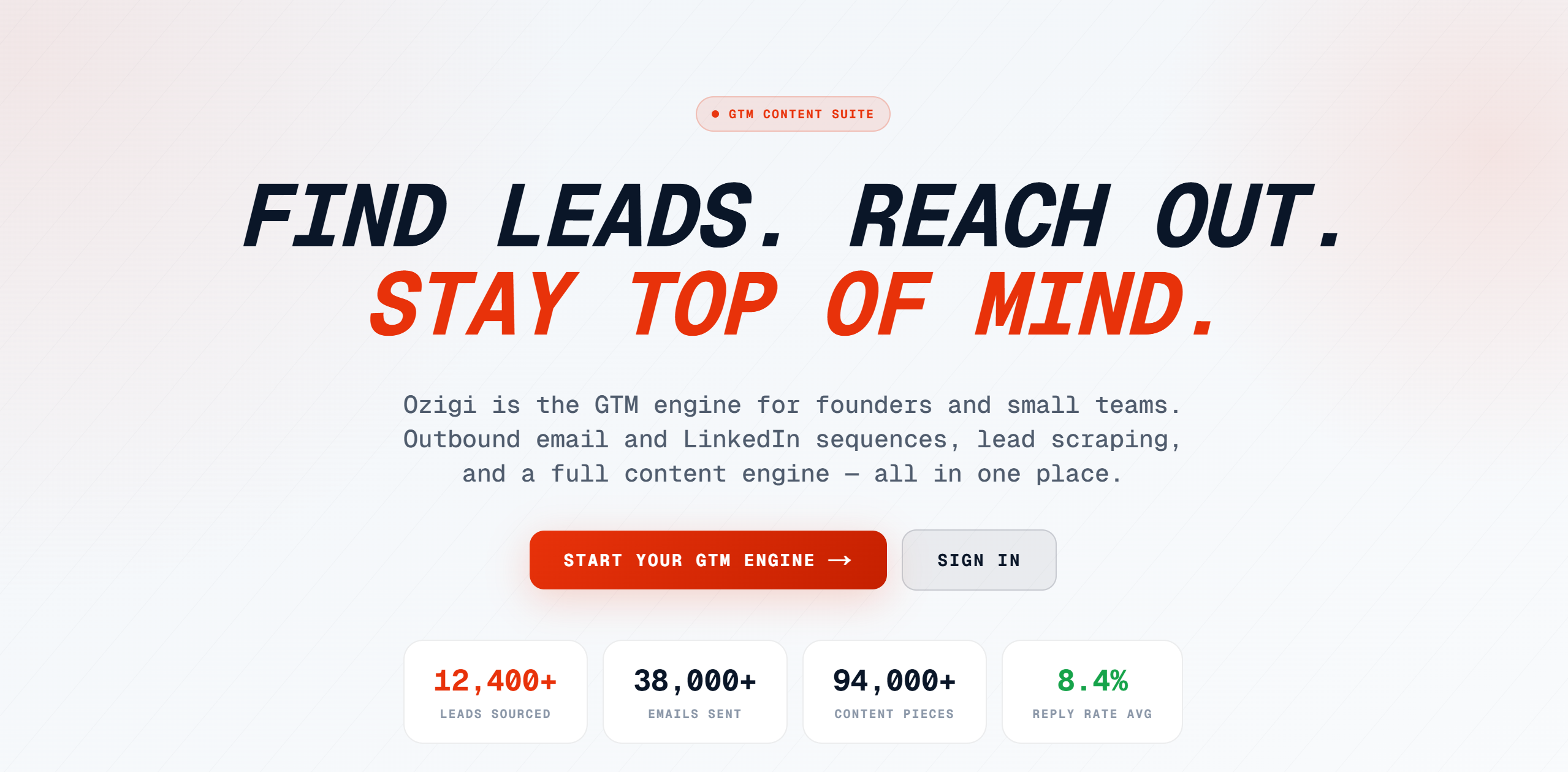
Ozigi is a go-to-market engine for founders, DevRel teams, and small technical teams. It handles the four jobs that fill pipeline: finding the right people, qualifying them against your ICP, reaching them with outreach that sounds human, and publishing the content that warms the market before the ask lands.
The two engines share one brain. The same persona voice that writes your LinkedIn sequence also writes your blog post. The same Banned Lexicon that keeps your cold email off the spam filter keeps your newsletter from sounding like it was generated. You define your voice once; it applies everywhere.
Lead sourcing Source leads directly from GitHub, Dev.to, npm, Hacker News, and LinkedIn based on an ICP you define once. For GitHub, the engine runs a bio-keyword + language + location query against the GitHub user search API and extracts matching profiles. When a profile hides its email, the engine recovers a real address from the user's public commit history. For Dev.to, it pulls authors by tag. LinkedIn search runs in the browser extension, against your own logged-in session — it is the only source that yields a LinkedIn profile URL, and so the only one that feeds LinkedIn outreach.
ICP scoring Every sourced lead is scored by Gemini against your ICP on a 0.0–1.0 scale. Only leads above your threshold enter the sequence. This keeps your sending lists clean and your reply rates high without manual filtering.
Email + LinkedIn sequences Campaigns run multi-step sequences from your own accounts with delays you control. Per-channel daily limits protect your domain reputation and LinkedIn standing. Reply detection pauses a sequence the moment someone responds on either channel. CRM sync (HubSpot, Zoho, Salesforce via Composio OAuth; Swipe One via API key) pushes leads on first contact.
Email sends server-side. LinkedIn is the browser extension — Ozigi for LinkedIn on the Chrome Web Store — which both finds the leads and sends the connection requests, inside your own logged-in tab, because LinkedIn withholds search results and the Connect button from flagged headless sessions. The LinkedIn channel is the connection request with a personalised note; Ozigi does not send LinkedIn DMs.
Drop in a URL, paste raw notes, or upload a PDF or image. Ozigi extracts the core narrative and returns polished, platform-specific drafts for X (Twitter), LinkedIn, Discord, Slack, and email newsletters — all in your voice, with the Banned Lexicon applied.
Generate full blog posts, tutorials, and technical documentation in MDX-ready format from the long-form module. Pick who the piece is for and the engine calibrates jargon, code, analogies, and how claims are evidenced to that reader. Every long-form draft is then audited before you see it — for AI cadence, for code that breaks on paste, and for whether it actually landed on the audience you asked for. Write, schedule, and send email newsletters directly from the dashboard. Manage your subscriber list and track delivery.
The single most important reason Ozigi doesn't sound like AI. A hard-coded blocklist enforced at the API route level — not filtered after generation, blocked during it. No "delve", no "robust", no "seamlessly", no "tapestry", no "game-changing". The model is penalised for AI-speak vocabulary, which forces every sentence to be constructed from your actual content. Applied identically to cold email, blog posts, LinkedIn posts, and newsletter copy.
The Banned Lexicon blocks the words. This catches everything a word list can't reach. A model routes around a blocklist by picking a synonym, but it can't synonym its way out of thirty paragraphs of identical length, four sentences opening with "You", a question transitioning into every section, or the same point restated in three places. Seventeen detectors run over every long-form draft after generation and return a structural score out of 100 with each flag anchored to a specific span.
The same pass reads every code block for leaked credentials, injectable SQL, and — the one that bites readers most — smart quotes and non-breaking spaces, which are invisible on the page and a syntax error the moment someone pastes the snippet. Those two are hard errors that block publication; style flags are advisory. It also checks the draft against the reader you selected and the content mode you picked, so a beginner tutorial that assumes fluency or a how-to with no steps gets caught before you do. Pure computation, no second model call: ~10ms on a 2,500-word article. Read the deep dive.
Define who is writing — role, tone, beliefs, things they would never say — and save it once. Every campaign generation, every outreach step, and every content piece applies that persona automatically. One setup, consistent voice forever, across both engines.
Generate platform-aware graphics directly inside the engine. Blank field = abstract background matched to the post topic. Add a graphic title = rendered text graphic with clean typography. Generated images upload server-side to Cloudflare R2 storage and return a public CDN URL — no browser CORS issues, no extra pipeline.
Ozigi handles the 90% — extraction, structure, constraints, platform formatting. You own the 10% — the specific detail, the insider context, the judgment call only a human can make. Every generated campaign includes an Edit step before it goes anywhere.
A context-aware AI assistant built into the dashboard. Copilot has access to your current campaign context, your personas, and optionally the web. It handles ideation, draft refinement, outreach critique, and persona development.
| Plan | Price | What it covers |
|---|---|---|
| Free | $0, no card | 50 lead credits/mo · 1 campaign · 30 email sends · 3 content pieces · 1 persona |
| Starter | $19/mo | Full content engine · 30 campaigns · image gen · newsletter sending · scheduling |
| Growth | $29/mo | GTM only · 1,000 credits/mo · unlimited sends · LinkedIn · CRM sync |
| Pro | $49/mo | Both engines, no limits · Copilot · long-form · analytics |
| Enterprise | Custom | Custom volume · SLA · white-label · dedicated onboarding |
Credit bundles (for Starter users who need outbound without upgrading): 200 credits for $5 · 500 for $10 · 1,500 for $25. Credits stack and never expire.
Payments are processed by Dodo Payments. Subscriptions and bundles both go through the Dodo checkout API. The dashboard fires a Google Ads conversion event on successful subscription (?checkout=success) and credit bundle (?checkout=credits) returns.
| Layer | Technology |
|---|---|
| Frontend | Next.js (App Router), React, Tailwind CSS |
| Backend | Next.js Route Handlers, Vercel Serverless |
| AI — Text | Google Cloud Vertex AI (Gemini 3.1 Flash) |
| AI — Image | Gemini 3.1 Flash Image via Vertex AI |
| Database & Auth | Supabase (PostgreSQL + Auth) |
| Object Storage | Cloudflare R2 |
| Rate Limiting & Scheduling | Upstash Redis + QStash |
| Payments | Dodo Payments |
| CRM Integration | Composio (HubSpot · Zoho · Salesforce) · Swipe One (API key) |
| Analytics | Vercel Analytics · Google Ads (AW tag) · Ahrefs · Ghostly |
| ZeptoMail | |
| Testing | Playwright |
Requires Node.js v18+ and pnpm.
# Clone the repo
git clone https://github.com/Ozigi-app/OziGi.git
cd OziGi

# Install dependencies
pnpm install

# Set up environment variables
cp .env.example .env.local
# Fill in credentials (see below)

# Start the main app
pnpm dev

# Start the blog (separate Next.js app)
cd apps/blog && pnpm dev
Open http://localhost:3000 for the main app, http://localhost:3001 for the blog.
# Supabase
NEXT_PUBLIC_SUPABASE_URL=
NEXT_PUBLIC_SUPABASE_ANON_KEY=
SUPABASE_SERVICE_ROLE_KEY=

# Google Cloud / Vertex AI (text + image generation)
GOOGLE_CLOUD_PROJECT_ID=
GOOGLE_CLOUD_CLIENT_EMAIL=
GOOGLE_CLOUD_PRIVATE_KEY=

# Cloudflare R2 (image storage)
R2_ENDPOINT=
R2_ACCESS_KEY_ID=
R2_SECRET_ACCESS_KEY=
R2_BUCKET_NAME=
NEXT_PUBLIC_R2_DOMAIN=

# Upstash — rate limiting (Redis) + scheduled posts (QStash)
UPSTASH_REDIS_REST_URL=
UPSTASH_REDIS_REST_TOKEN=
QSTASH_TOKEN=
QSTASH_CURRENT_SIGNING_KEY=
QSTASH_NEXT_SIGNING_KEY=

# Dodo Payments
DODO_API_KEY=

# Composio — CRM + GitHub OAuth
COMPOSIO_API_KEY=
COMPOSIO_GITHUB_AUTH_CONFIG_ID=

# App URL (used in checkout return URLs)
NEXT_PUBLIC_APP_URL=

# Google Ads
NEXT_PUBLIC_GTAG_ID=The architecture page at ozigi.app/architecture covers the four live decisions that shaped the engine: LLM selection and why Gemini Flash beats Claude for this pipeline, JSON schema enforcement, the GTM sourcing and scoring architecture, and how the image generation pipeline routes through R2.
Open an issue or submit a PR. The roadmap is public. Vibe-coded contributions are explicitly welcome — bring your instincts, run the tests, and ship the fix. See CONTRIBUTING.md for the full guidelines.
Dumebi Okolo — Founder and CEO of Ozigi
X / Twitter · LinkedIn · DEV.to